
Summary of Different Types of American Nationals
During both administrative correspondence and litigation, it is commonplace for the government to either equivocate or compartmentalize the various types of American nationals so that they can deceive you into not claiming a particular status. Below is a summary of the various statuses found in statutes, on government forms, and in the common law to prevent that deception:
1. TABLE
| # | Status | Context | Origin | 8 U.S.C. §1101(a)(22) | 8 U.S.C. §1101(a)(22)(A) | 8 U.S.C. §1101(a)(22)(B) | 22 C.F.R. §51.1 “U.S.** national”? | 22 C.F.R. §51.2 “U.S. National” | Common Law American national |
| 1 | “citizen* of the United States50“ | All | Fourteenth Amendment | No | No | No | No | Yes | Yes |
| 2 | “United StatesP national” | Government forms | 8 U.S.C. §1408 8 U.S.C. §1452 | Yes | No | Yes | Yes | Yes | No |
| 3 | “citizen* of the United StatesSMJ“ | Tax forms | 26 C.F.R. §1.1-1(a) | Yes | Yes | No | No | Yes | No |
| 4 | “national of the United StatesP“ | Taxes | 26 U.S.C. §873 26 C.F.R. §1.1441-1(c)(3)(i) | Yes | Yes | Yes | Yes | Yes | Yes |
| 5 | “American national” | Department of State | 8 U.S.C. §1502 | Yes | Yes | Yes | No | Yes | Yes |
| 6 | “national” | Citizenship | 8 U.S.C. §1101(a)(21) | No | No | No | No | Yes | Yes |
| 7 | “United StatesP national” | IRS Publications | 8 U.S.C. §1408 8 U.S.C. §1452 | Yes | No | Yes | Yes | Yes | No |
| 8 | “citizen of the United StatesP“ | USCIS I-9 Form | Any | Yes | Yes | No | No | No | Yes |
| 9 | “noncitizen national of the United StatesP“ | USCIS I-9 Form | 8 U.S.C. §1408 8 U.S.C. §1452 | Yes | No | Yes | Yes | Yes | No |
| 10 | “United StatesP citizen” | SS-5 Form | 8 U.S.C. §1401 | Yes | Yes | No | No | Yes | No |
NOTES:
- For a description of our citizenship terminology, see:
Website Definitions, Section 33: “Citizen” and “Citizen*+D” and “Citizenship”, FTSIG
https://ftsig.org/advanced/definitions/#33._Citizen - For reasons and methods for government to OBFUSCATE the above, see the following article:
PROOF: Why the government CAN’T AND WON’T RECOGNIZE PRIVATE OF FOREIGN and ONLY RECOGNIZES PUBLIC and DOMESTIC, FTSIG
https://ftsig.org/proof-why-the-government-cant-and-wont-recognize-private-of-foreign-and-only-recognizes-public-and-domestic/ - There are TWO main contexts for the term “citizen”
3.1. POLITICAL Citizen* and defined in 8 U.S.C. §1401 or the Fourteenth Amendment.
3.2. CIVIL/DOMICILED Citizen**+D domiciled within the exclusive jurisdiction of the government you are talking to. - All the above confusion is a product of the desire to DECEIVE you into believing or claiming that the TWO contexts for “citizen” are either the same or can be used interchangeably.
- The ONLY way to deal properly with EQUIVOCATORS and SOPHISTS is to define which if the two contexts that it is and which it ISN’T.
- We therefore ALWAYS recommend a mandatory attachment when filling out any government form that asks whether you are a “citizen of the United States” or “U.S. citizen” because they never define WHICH United States they are talking about. Below is a good example:
Affidavit of Citizenship, Domicile, and Tax Status, Form #02.001
https://sedm.org/Forms/02-Affidavits/AffCitDomTax.pdf - 22 U.S.C. §212 and 22 C.F.R. §51.2 use “United StatesP national” and “national of the United StatesP” interchangeably.
- 22 C.F.R. §51.2 incorporates BOTH a COMMON LAW American national and a STATUTORY “U.S.** national” mentioned in 22 C.F.R. §51.1.
- A COMMON LAW American national is someone that a court calls an American national but doesn’t link to a specific statute in Title 8.
- Congress CANNOT BY LEGISLATION REVISE, REPEAL, or even DEFINE terms found in the constitution from which it derives its authority. That is why Fourteenth Amendment citizens are NOT mentioned anywhere in Title 8 of the U.S. Code or even in the Internal Revenue Code. All the “citizens” in any enactment of Congress such as Title 8 are always EXTRACONSTITUTIONAL citizens in territories or possessions, meaning they are not party to or mentioned in the Constitution.
- Common law “American nationals” are referenced in:
11.1 USA v. Michael Little, No. 12-cr-647(PKC)., U.S.D.C. 2017 1 (2017)
Google Scholar: https://scholar.google.com/scholar_case?case=862310981064929702
11.2. Coplin v. United States, 6 ClsCt 115 (1985);
Google Scholar: https://scholar.google.com/scholar_case?case=5422401643079916168&
Other cite: http://famguardian.org/TaxFreedom/CitesByTopic/USNational-Paul H Coplin et ux Plaintiffs v The United States-6-ClsCt-115-1985-USNational.pdf
11.3. Xerox v. United States , 14 ClsCt 455 (1986)
Other cite: http://famguardian.org/TaxFreedom/CitesByTopic/USNational-Xerox Corporation Plaintiff v The United States-14-Cls-455-1986-USNational.pdf
11.4. Readings and Bates Corporation and Subsidiaries v. United States, 40 FedCl 737 (1998)
Other cite: http://famguardian.org/TaxFreedom/CitesByTopic/USNational-Reading amp Bates Corporation and Subsidiaries Plaintiff v The United States-40-FedCl-737-1998-USNational.pdf
11.5. Korn v. Commissioner, 32 T.C.M. 1220, 524 F.2d. 888 (1975)
Google Scholar: https://scholar.google.com/scholar_case?case=7529641744710388861
11.6. Korn. v C.I.R., 425 F.2d. 888 (1975)
Google Scholar: https://scholar.google.com/scholar_case?case=13492524255712146582
Other cite: http://famguardian.org/TaxFreedom/CitesByTopic/USNational-Michael Korn Petitioner-Appellant v Commissioner of Internal Revenue-524-F2d-888-1975-USNational.pdf
2. DIAGRAMS
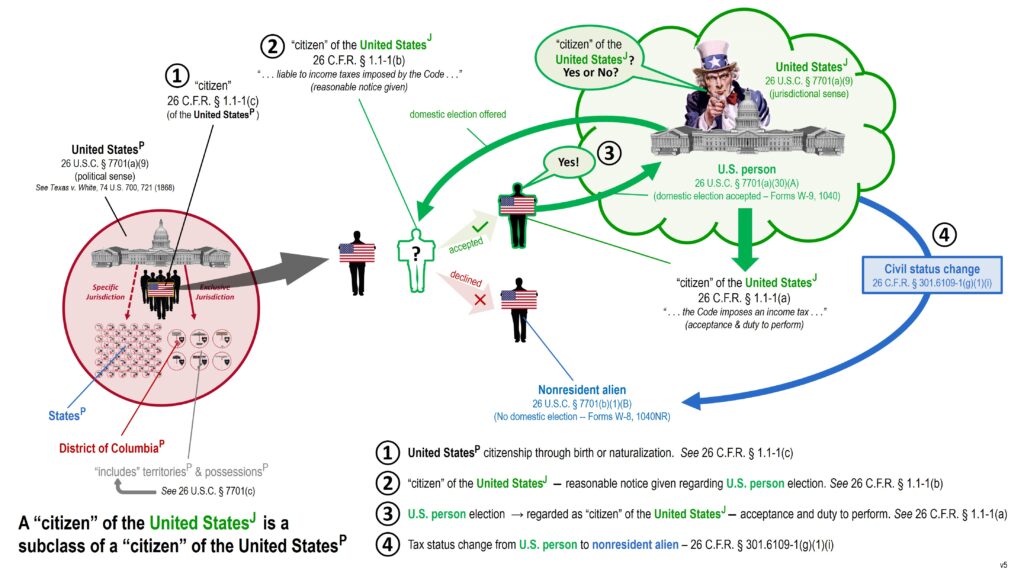
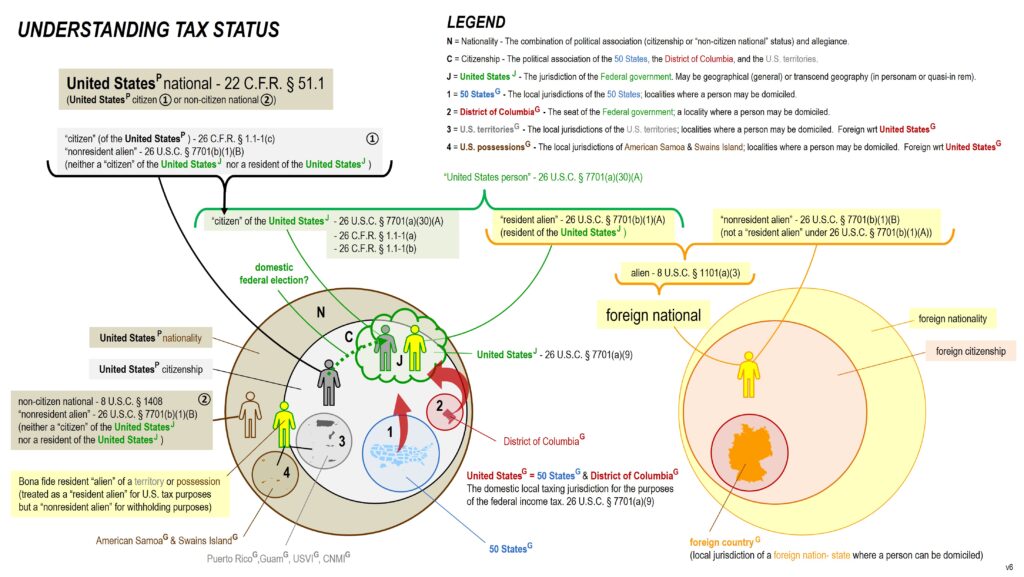
3. Types of Nonresident Aliens
The table below summarizes the various types of nonresident aliens and the symbology used on this site to represent them.
| # | Symbology | Description | U.S. national? | Federal preemption applies? | Constitutional protections? | Fundamental Rights Doctrine ProtectIons? |
| 1 | NRAA | Foreign national | N | Y | N | N |
| 2 | NRA50 | “citizen” of one of the 50 states | Y | N | Y | N |
| 3 | NRAt | “citizen” of an organized territory | Y | N | Y | Y |
| 4 | NRAp | non-“citizen” national of American Samoa (unorganized possession); | Y | N | N | Y |
| 5 | NRAt+p | “citizen” of CNMI who has elected non-“citizen” national status (i.e., waiver of “citizen” status) | Y | N | N | Y |
| 6 | NRAT | “citizen” of Palmyra Atoll (an unorganized incorporated Territory—Constitution applies in full) | Y | N | Y | Y |
For a discussion of the Fundamental Rights Doctrine and Constitutional Protections in the above table, see:
PROOF: Unconstitutional Conditions Doctrine Applies to Federal Territories and Possessions, FTSIG
https://ftsig.org/proof-unconstitutional-conditions-doctrine-applies-to-federal-territories-and-possessions/
We do think it’s important to be as accurate as possible and lead people to think critically about these statuses, what they mean, and what the exceptions are. Examples of how they could be misapplied to invite frivolous accusations:
- “The Bill of Rights applies only in the 50 States and D.C.”. This is wrong because it also applies to the Palmyra Atoll which was part of the incorporated Territory of Hawaii, but was excepted from Hawaii when it was granted statehood.
- “Everybody from an organized territory is a “citizen” under 26 C.F.R. §1.1-1(c).” No. What about domiciliaries of the CNMI who have elected to be treated as non-citizen nationals?
The classes in the above table are each unique and different. Therefore they are treated differently. Breaking the types of NRAs down into the above categories:
- Helps people better understand the different nuances of citizenship, nationality, and tax status.
- Gives people a better understanding of the implications of a term that defines what something is not.
- Provides a way to DEFLECT frivolous accusations by sophists in what Mark Twain called “the District of Criminals” that divert discussion to red herring issues.
Third rail issues about this subject the government doesn’t like to discuss and hides as much as possible include:
- That most Americans will never be able to understand the difference between citizenship and nationality.
1.1. They know most Americans just blindly adopt “U.S. citizen.”
1.2. If any tax professional tells them that a U.S. national is the folks from the items 3-6 because they’re not part of the 50 States or D.C. (a dangerous partial truth for them), they’ll accept it and not look back. After all, they’re just “colonists”—not citizens.
1.3. Nationality is political status.
1.4. Civil status is imputed through citizenship + domicile. - In the case of a domestic election (citizen**+D), it’s the domicile of the franchisor that is relevant. The local status (domicile) of the citizen is no longer relevant, and he becomes a citizen**+D of the United StatesG by federal preemption through the federal franchise.
- That NRA50
3.1. Must make a CIVIL citizen**+D election to owe a tax if they know they are nonresident aliens by default.
3.2. Is political citizens* who have not made a domestic election to become CIVIL citizens**+D.
3.3. Are U.S. nationals also per 22 C.F.R. §51.1. - Table Items 3-6 are:
4.1. NRAs forthrightly exposes the fact that the NRA status is not limited to foreign nationals, aka—aliens.
4.2. U.S. nationals. They have chosen the necessary truth that exposes the scheme the least.
More like the above third rail list in:
Catalog of Elections and Entity Types in the Internal Revenue Code, Section 5: How the IRS HIDES elections so you will MISTAKENLY make them, FTSIG
https://ftsig.org/catalog-of-elections-in-the-internal-revenue-code/#5._How
4. FURTHER READING AND RESEARCH
- Citizenship Status v. Tax Status, Form #10.011
http://sedm.org/Forms/10-Emancipation/CitizenshipStatusVTaxStatus/CitizenshipVTaxStatus.htm - How You are Illegally Deceived or Compelled to Transition from Being a POLITICAL Citizen to a CIVIL Citizen: By Confusing the Two Contexts, Family Guardian Fellowship
https://famguardian.org/Subjects/LawAndGovt/Citizenship/HowCitObfuscated.htm