
Civil Status (Association + Domicile)
1. Introduction
Association=Political citizen* under Fourteenth Amendment or 8 U.S.C. §1401-1408.
Domicile = voluntary local MUNICIPAL allegiance in a specific county or political subdivision.
Called a CIVIL/DOMICILED Citizen**+D on this site.
The law of England, and of almost all civilized countries, ascribes to each individual at his birth two distinct legal states or conditions,-one by virtue of which he becomes the subject of some particular country, binding him by the tie of natural allegiance, and which may be called his political status; another by virtue of which he has ascribed to him the character of a citizen of some particular country, and as such is possessed of certain municipal rights, and subject to certain obligations, which latter character is the civil status or condition of the individual, and may be quite different from his political status.
[United States v. Wong Kim Ark, 169 U.S. 649, 656 (1898)]
“He evidently used the word “citizen,” not as equivalent to “subject,” but rather to “inhabitant;””
[United States v. Wong Kim Ark, 169 U.S. 649, 657 (1898)]
“[C]ivil status is universally governed by the single principle of domicil, [or] domicilium, the criterion established by international law for the purpose of determining civil status, and the basis on which “the personal rights of the party . . . must depend;”
[United States v. Wong Kim Ark, 169 U.S. 649, 656-57 (1898)]
“Domicile is the place where one has his true, fixed, permanent home and principal establishment and to which, whenever he is absent, he has the intention of returning.”
2. Domicile
There are two classes of domicile:
- DomicilePRI is your natural, private‑capacity home—the place you physically live as a private person. It is voluntary, non‑statutory, and cannot create civil obligations. Courts have no sovereignPRI authority to impose taxation or civil duties on the basis of domicilePRI.
- DomicilePUB, by contrast, is a civil, statutory, intangible status created by judges and attached through public‑capacity elections (licenses, franchises, benefits, registrations). It is the domicile referenced in cases like Lawrence v. State Tax Commission and Kirtland v. Hotchkiss. This domicile is proprietaryPUB, not sovereignPRI. It exists only because the person has accepted civil benefits or privileges, and therefore the state claims the right to impose reciprocal burdens (taxation, reporting, civil compliance).
Courts pretend domicilePUB is domicilePRI, allowing them to frame proprietaryPUB taxation as “sovereign power.” But the underlying doctrine shows that the taxation is justified only by benefits, privileges, and civil protections—all proprietaryPUB concepts.
Doctrinal Table: DomicilePRI vs DomicilePUB
| Concept | DomicilePRI | DomicilePUB |
|---|---|---|
| Nature | Natural private home; factual physical residence | Judicially‑constructed civil status; intangible legal persona |
| Described in | Federal Rule of Civil Procedure 17(b)(1) | Federal Rule of Civil Procedure 17(b)(2)-(3) |
| Source of authority | Common‑law fact pattern; no constitutional text | Civil statutory law; franchises; benefits; judicial invention |
| Consent required? | Yes—private persons choose where they live | Yes—created only after voluntary public‑capacity election (licenses, registrations, benefits) |
| Capacity involved | Private capacity (personPRI) | Public capacity (personPUB) |
| Can courts compel it? | No—courts cannot compel domicilePRI | Yes—courts compel domicilePUB once you enter a franchise |
| Tax power attached? | None—no sovereignPRI tax authority | ProprietaryPUB tax authority (reciprocal burden for benefits) |
| Relationship to “benefits” | No benefits required; common‑law protections only | Benefits and privileges are the basis for taxation (“those who enjoy its benefits”) |
| Relationship to United StatesG vs United StatesJ | Geographical; relates to United StatesG | Intangible; domicile of the statutory office in United StatesJ |
| Involuntary? | Never | Never—though courts disguise voluntariness through civil presumptions |
| Used in cases like Lawrence, Kirtland, Maguire? | No | Yes—those cases rely exclusively on domicilePUB |
| Can it create civil statutory obligations? | No | Yes—only because it is a civil franchise status |
| Can it be renounced? | Yes (common‑law right to refuse benefits) | Yes (renunciation of civil franchises and statutory benefits) |
Why this distinction matters
The cases quoted (Lawrence, Kirtland, Maguire, Shaffer) in this section all rely on benefits, privileges, and protections—terms that cannot apply to private personsPRI unless they voluntarily enter public capacity.
Thus:
- When courts say “domicile establishes a basis for taxation,” they mean domicilePUB, not domicilePRI.
- When they say “those who enjoy its benefits,” they mean public‑capacity beneficiaries, not private persons.
- When they say “privileges enjoyed there,” they mean civil statutory privileges, not common‑law rights.
This is why domicilePUB is proprietaryPUB, not sovereignPRI. Domicile is a judicial invention not found in the constitution. We prove that below:
Copilot: Origin of domicile and authority of courts to use it, FTSIG-judges COMPELLING domicile
https://ftsig.org/copilot-origin-of-domicile-and-authority-of-courts-to-use-it/
Domicile is abused by corrupt judges to recruit you into economic and legal servitude to the OPTIONAL civil statutory law. Here is an example of that:
The obligation of one domiciled within a state to pay taxes there, arises from unilateral action of the state government in the exercise of the most plenary of sovereign powers, that to raise revenue to defray the expenses of government and to distribute its burdens equably among those who enjoy its benefits. Hence, domicile in itself establishes a basis for taxation. Enjoyment of the privileges of residence within the state, and the attendant right to invoke the protection of its laws, are inseparable from the responsibility for sharing the costs of government. See Fidelity & Columbia Trust Co. v. Louisville, 245 U.S. 54, 58; Maguire v. Trefry, 253 U.S. 12, 14, 17; Kirtland v. Hotchkiss, 100 U.S. 491, 498; Shaffer v. Carter, 252 U.S. 37, 50. The Federal Constitution imposes on the states no particular modes of taxation, and apart from the specific grant to the federal government of the exclusive 280*280 power to levy certain limited classes of taxes and to regulate interstate and foreign commerce, it leaves the states unrestricted in their power to tax those domiciled within them, so long as the tax imposed is upon property within the state or on privileges enjoyed there, and is not so palpably arbitrary or unreasonable as to infringe the Fourteenth Amendment. Kirtland v. Hotchkiss, supra.
Taxation at the place of domicile of tangibles located elsewhere has been thought to be beyond the jurisdiction of the state, Union Refrigerator Transit Co. v. Kentucky, 199 U.S. 194; Frick v. Pennsylvania, 268 U.S. 473, 488-489; but considerations applicable to ownership of physical objects located outside the taxing jurisdiction, which have led to that conclusion, are obviously inapplicable to the taxation of intangibles at the place of domicile or of privileges which may be enjoyed there. See Foreign Held Bond Case, 15 Wall. 300, 319; Frick v. Pennsylvania, supra, p. 494. And the taxation of both by the state of the domicile has been uniformly upheld. Kirtland v. Hotchkiss, supra; Fidelity & Columbia Trust Co. v. Louisville, supra; Blodgett v. Silberman, 277 U.S. 1; Maguire v. Trefry, supra; compare Farmers Loan & Trust Co. v. Minnesota, 280 U.S. 204; First National Bank v. Maine, 284 U.S. 312.
[Lawrence v. State Tax Commission, 286 U.S. 276 (1932); SOURCE: https://scholar.google.com/scholar_case?case=10241277000101996613]
The civil statutory law, in turn, is a Private Membership Association that is optional and proprietary. You don’t have to join it an no one can force you to. We prove this in:
Why Domicile and Becoming a “Taxpayer” Require Your Consent, Form #05.002
https://sedm.org/Forms/05-MemLaw/Domicile.pdf
Notice in the above case the phrase “among those who enjoy its benefits.” You have a common law right to REFUSE all benefits, and thus RETAIN your private capacity and ONLY common law and criminal law protections.
“A person is ordinarily not required to pay for benefits which were thrust upon him with no opportunity to refuse them. The fact that he is enriched is not enough, if he cannot avoid the enrichment.” Wade, Restitution for Benefits Conferred Without Request, 19 Vand. L. Rev. at 1198 (1966). [Siskron v. Temel-Peck Enterprises, 26 N.C.App. 387, 390 (N.C. Ct. App. 1975)]
“Quilibet potest renunciare juri pro se inducto. Any one may renounce a law [including a CIVIL FRANCHISE statute] introduced for his own benefit.”
[Bouvier’s Maxims of Law, 1856;
SOURCE: https://famguardian.org/Publications/BouvierMaximsOfLaw/BouviersMaxims.htm]
“The power of taxation, indispensable to the existence of every civilized government, is exercised upon the assumption of an equivalent rendered to the taxpayer in the protection of his person and property, in adding to the value of such property, or in the creation and maintenance of public conveniences in which he shares, such, for instance, as roads, bridges, sidewalks, pavements, and schools for the education of his children. If the taxing power be in no position to render these services, or otherwise to benefit the person or property taxed, and such property be wholly within the taxing power of another State, to which it may be said to owe an allegiance and to which it looks for protection, the taxation of such property within the domicil of the owner partakes rather of the nature of an extortion than a tax, and has been repeatedly held by this court to be beyond the power of the legislature and a taking of property without due process of law. Railroad Company v. Jackson, 7 Wall. 262; State Tax on Foreign-held Bonds, 15 Wall. 300; Tappan v. Merchants’ National Bank, 19 Wall. 490, 499; Delaware &c. R.R. Co. v. Pennsylvania, 198 U.S. 341, 358. In Chicago &c. R.R. Co. v. Chicago, 166 U.S. 226, it was held, after full consideration, that the taking of private property 203*203 without compensation was a denial of due process within the Fourteenth Amendment. See also Davidson v. New Orleans, 96 U.S. 97, 102; Missouri Pacific Railway v. Nebraska, 164 U.S. 403, 417; Mount Hope Cemetery v. Boston, 158 Massachusetts, 509, 519.”
[Union Refrigerator Transit Company v. Kentucky, 199 U.S. 194, 202-203 (1905);
SOURCE: https://scholar.google.com/scholar_case?case=14163786757633929654]
Domicile is exhaustively covered in the following articles:
- Copilot: PRIVATE domicile v. PUBLIC domicile, FTSIG
https://ftsig.org/copilot-private-domicile-v-public-domicile/ - PROOF: Domicile is a Civil Statutory Membership System, FTSIG
https://ftsig.org/reference-domicile-as-civil-statutory-membership/ - HOW TO: Distinguishing Domicil v. Domicile, FTSIG
https://ftsig.org/how-to-distinguishing-domicil-v-domicile/ - Why Domicile and Becoming a “Taxpayer” Require Your Consent, Form #05.002
http://sedm.org/domicile - Why Domicile and Becoming a “Taxpayer” Require Your Consent, Family Guardian Fellowship
https://famguardian.org/Subjects/Taxes/Remedies/DomicileBasisForTaxation.htm - Copilot: Origin of domicile and authority of courts to use it, FTSIG
https://ftsig.org/copilot-private-domicile-v-public-domicile/
3. Tax Home
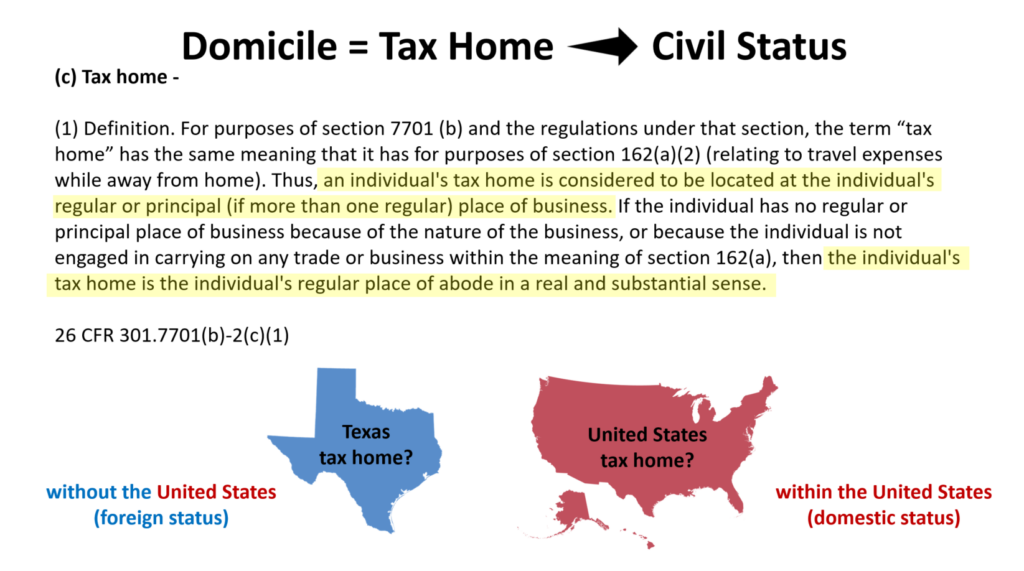
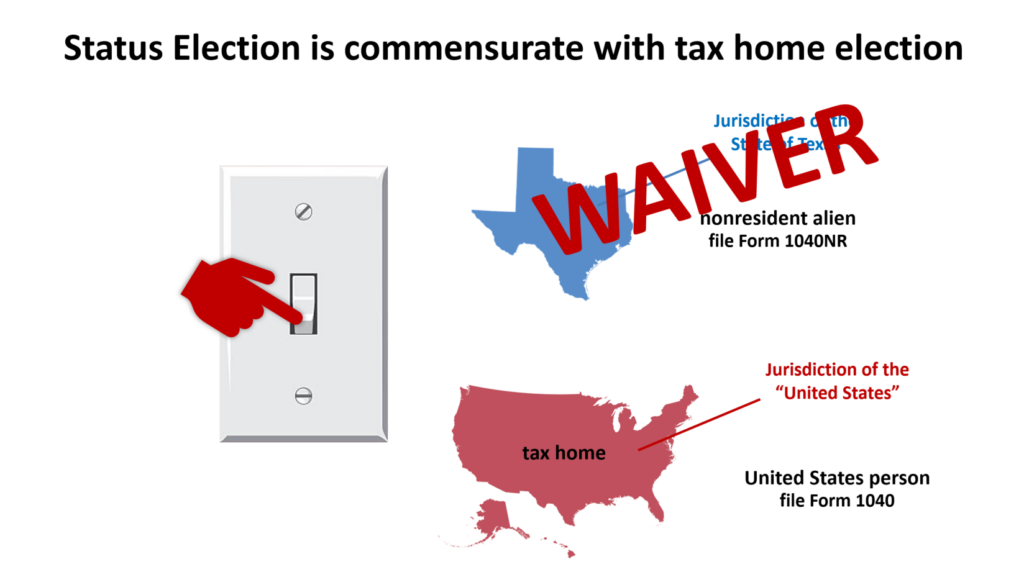
Tax home is more thoroughly covered in:
DEFINITIONS: Tax Home (domicile of a public office if you volunteered to be surety for a “taxpayer” public capacityPUB), FTSIG
https://ftsig.org/definitions-tax-home/
4. Foreign country
The 50 states are CIVILLY and LEGISLATIVELY foreign with respect to the national government, PROVIDED we properly aver our status as a “nonresident alien” and file the CORRECT 1040NR tax return as an American national born within a constitutional state and residing there:
(b) Foreign country.
For purposes of section 7701(b) and the regulations thereunder, the term “foreign country” when used in a geographical sense includes any territory under the sovereignty of the United Nations or a government other than that of the United States. It includes the territorial waters of the foreign country (determined in accordance with the laws of the United States), and the seabed and subsoil of those submarine areas which are adjacent to the territorial waters of the foreign country and over which the foreign country has exclusive rights, in accordance with international law, with respect to the exploration and exploitation of natural resources. It also includes the possessions and territories of the United States.
[26 C.F.R. §301.7701(b)-2]
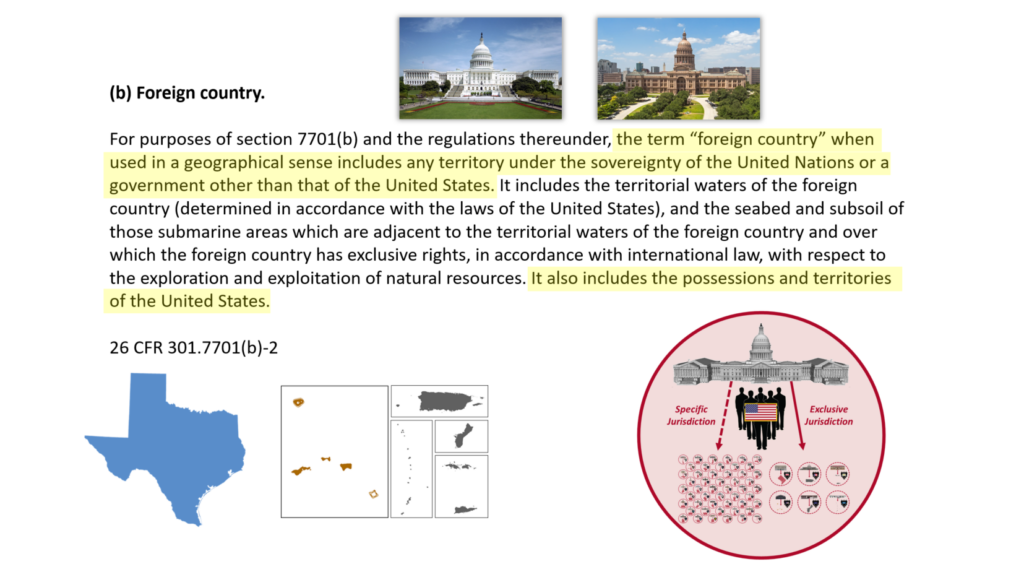
Note the phrase above “when used in a geographical sense includes any territory under the sovereignty of the United Nations or a government other than that of the United States.” States of the Union fit in this category.
Foreign Laws:“The laws of a foreign country or sister state. In conflicts of law, the legal principles of jurisprudence which are part of the law of a sister state or nation. Foreign laws are additions to our own laws, and in that respect are called ‘jus receptum’.”
[Black’s Law Dictionary, 6th Edition, p. 647]
Foreign Laws:“The laws of a foreign country or sister state. In conflicts of law, the legal principles of jurisprudence which are part of the law of a sister state or nation. Foreign laws are additions to our own laws, and in that respect are called ‘jus receptum’.”
[Black’s Law Dictionary, 6th Edition, p. 647]
foreign: not being within the jurisdiction of a political unit (as a state)
esp
: being from or in a state other than the one in which a matter is being consideredExample: a foreign company doing business in South Carolina
Example: a foreign executor submitting to the jurisdiction of this court
Example: a foreign judgment
(compare domestic)
[Merriam-Webster’s Dictionary of Law ©1996]
5. Why States of the Union are included in the definition of “foreign country” for nonresident alien U.S. nationals
The use of the word “includes” in the definition of “foreign country” in 26 C.F.R. §301.7701(b)-2(b) definition of “foreign country” implies a CLASS of items in the definition per 26 U.S.C. §7701(c) which doesn’t list all the members of the parent class. The reason states of the Union are not explicitly mentioned is as members of the class identified as “government other than that of the United States.” is fear of exposing the voluntary nature of the income tax in I.R.C. Subtitle A within states of the Union as we show in the following article.
CORRUPTION: Treasury Expressly Excluding States of the Union from The Definition of “foreign country” is Unconstitutional and Policy Motivated, FTSIG
https://ftsig.org/corruption-treasury-expressly-excluding-states-of-the-union-from-the-definition-of-foreign-country-is-unconstitutional-and-policy-motivated/
Recognizing states of the Union as “foreign countries” ONLY for the purposes of I.R.C. Subtitle A would entirely collapsing income tax enforcement there, even though the Unconstitutional Conditions Doctrine mandates this collapse:
Copilot: Unconstitutional Conditions Doctrine applied to Federal and State Income Taxation, FTSIG
https://ftsig.org/copilot-unconstitutional-conditions-doctrine-applied-to-federal-and-state-income-taxation/
6. How government forms trick you into volunteering for a PUBLIC capacityPUB
Filing a civil form is not a neutral act. Every non‑physical assertion on the form is a legal conclusion that, once adopted, creates an intangible federal office (capacityPUB) domiciled in United StatesJ, not United StatesG. This transition is the mechanism by which a private personPRI becomes surety for a statutory persona.
Government forms cannot rely on physical facts to create civil obligations because civil statutory obligations attach only to intangible offices. Therefore, forms must smuggle in legal conclusions—identity, status, capacity, domicilePUB—under penalty‑of‑perjury language that cannot lawfully validate them.
The moment you adopt a statutory persona, its domicilePUB is automatically United StatesJ, which is “domestic” for civil purposes. Your private domicilePRI remains “foreign” to federal civil jurisdiction, but becomes irrelevant once you become surety for the office.
There is no liability statute that makes I.R.C. Subtitle A income tax mandatory for anyone other than withholding agents on aliens in 26 U.S.C. §1461. Therefore, everyone other than withholding agents on aliens are volunteers. But you EVEN have to volunteer to become a “withholding agent” 26 U.S.C. §7701(a)(16) and be appointed by the Secretary of the Treasury using form 2678. A withholding agent is an officer of the United States for limited proprietary purposes. Under the anti‑peonage doctrine, no one can be involuntarily conscripted into federal office. Therefore, withholding agents must be voluntary.
They had to do it this way or else slavery, involuntary servitude, human trafficking, and peonage would be the inevitable result as explained below:
Proof that Involuntary Income Taxes on Your Labor are Slavery, Form #05.055
https://sedm.org/Forms/05-MemLaw/ProofIncomeTaxLaborSlavery.pdf
There are several paths to volunteer, and the civil public capacity you choose when filing (“U.S. person” or “Nonresident alien”) determine the obligations resulting from volunteering. The fact that you are volunteering is HIDDEN by abusing the legal imitations on ministerial officers at the IRS:
- Civil statutory status and public capacityPUB are intangible property.
- Everything DESCRIBING a public capacityPUB that you might enter on a government form requires a legal conclusion.
- Legal conclusions are not FACTS.
- You can’t be FORCED to engage in legal conclusions and it is unauthorized practice of law to do so before a court.
- Everything OTHER than physical facts that you ADD to government form requires a legal conclusion. This includes ALL the fields on the form that connect you to a civil statutory public capacityPUB.
- IRS forms are signed under penalty of perjury.
- Perjury statements CANNOT validate a legal conclusions.
- Ministerial officers at the IRS cannot use your perjury statement to launder a legal conclusion INTO a physical fact. That is fraud.
- Ministerial officers lack judicial power and therefore cannot adjudicate status, capacity, or domicile. Any attempt to treat your perjury statement as a judicial determination is ultra vires and constitutes identity laundering.
More on the above at:
- Avoiding Traps in Government Forms Course, Form #12.023
http://sedm.org/LibertyU/AvoidingTrapsGovForms.pdf - HOW TO: Distinguishing “Facts” from “Legal Conclusions”, FTSIG
https://ftsig.org/how-to-distinguishing-facts-from-legal-conclusions/ - REFERENCE: 1040NR Form Line Items Identification as Fact or Legal Conclusion, FTSIG
https://ftsig.org/reference-1040nr-form-line-items-identification-as-fact-or-legal-conclusion/
Once you UNKNOWINGLY volunteer by filling out a government form, you adopt a public capacityPUB and become surety for it. That voluntary surety transitions you from “foreign” and PRIVATE to “domestic” and PUBLIC. This is why Scripture warns that suretyship is a trap: it binds you to obligations that do not attach to you as a private man or woman, but only to the office you have adopted.
Dangerous Promises
6 My son, if you become surety for your friend,
If you have shaken hands in pledge for a stranger [or a LEGISLATIVELY FOREIGN government],
2 You are snared by the words of your mouth;
You are taken by the words of your mouth.
3 So do this, my son, and deliver yourself;
For you have come into the hand of your friend:
Go and humble yourself;
Plead with your friend.
4 Give no sleep to your eyes,
Nor slumber to your eyelids.
5 Deliver yourself like a gazelle from the hand of the hunter,
And like a bird from the hand of the fowler.[Prov. 6:1-5, Bible, NKJV]
WATCH OUT!
In civil law, suretyship attaches only to persons, and the statutory “person” in Title 26 is an intangible office. By signing the form, you become surety for that office, not for yourself as a private man or woman.
“U.S. person” is always a public‑capacityPUB because “person” is the privilege trigger. “Nonresident alien” is private‑capacityPRI until you voluntarily add “individual,” which converts it into a public‑capacityPUB office. Once you become surety for that office, courts treat the office’s domicilePUB as your operative domicile for civil purposes, even though your private domicilePRI never changes.
1. “U.S. person” contains the privilege trigger “person.”
“U.S. person” is always a public‑capacityPUB because:
- person is the privilege trigger in Subtitle A.
- “U.S.” is the jurisdictional modifier that ties the office to United StatesJ.
- Together, “U.S. person” is a civil statutory persona that cannot describe a private human being.
Thus:
U.S. person = personPUB = privileged civil office = always PUBLIC.
There is no private interpretation of “U.S. person.”
2. “Nonresident alien” contains no privilege trigger until “individual” is added.
This is the key distinction.
- nonresident → descriptor
- alien → descriptor
- individual → privileged civil office (personPUB)
Thus:
nonresident alien = private descriptor (PRI) nonresident alien individual = public office (PUB)
This is why:
- “nonresident alien” alone is private capacityPRI
- “nonresident alien individual” is public capacityPUB
And the transition from PRI → PUB occurs only through voluntary election, typically via:
- Form 1040NR
- Form W‑8BEN
- Form W‑9
- Any form that adds individual or person to the descriptor
This is the FTSIG rule:
Descriptors are private. Offices are public. The privilege attaches only to the office.
These distinctions are described in:
Writing Conventions on this Website, Section 1.2: Privilege/Obligation Origination
https://ftsig.org/introduction/writing-conventions-on-this-website/#1.2._Privilege
Every civil obligation in Subtitle A arises only after a voluntary transition from private capacityPRI to public capacityPUB through legal‑conclusion laundering on government forms. Without that voluntary act, no civil statutory liability can constitutionally attach.
7. Further Reading on this subject
- “Sovereign”=”Foreign”-Family Guardian Fellowship
https://famguardian.org/Subjects/Freedom/Sovereignty/Sovereign=Foreign.htm - Why Domicile and Becoming a “Taxpayer” Require Your Consent, Form #05.002
https://sedm.org/Forms/05-MemLaw/Domicile.pdf - Why Domicile and Becoming a “Taxpayer” Require Your Consent, Family Guardian Fellowship
https://famguardian.org/Subjects/Taxes/Remedies/DomicileBasisForTaxation.htm - Why Statutory Civil Law is Law for Government and not Private Persons, Form #05.037
https://sedm.org/Forms/05-MemLaw/StatLawGovt.pdf - Copilot: Origin of domicile and authority of courts to use it, FTSIG-judges COMPELLING domicile
https://ftsig.org/copilot-origin-of-domicile-and-authority-of-courts-to-use-it/