
Political Status (Association + Allegiance)
TABLE OF CONTENTS:
- Introduction
- National citizenship: 50 States & DC. U.S. Cont., Amendment XIV
- National citizenship: U.S. territories. Act of Congress via U.S. Const. Art. IV, Sec. 3. Clause 2
- National citizenship: Birth Abroad. Act of Congress via doctrine of jus sanguinis. 8 U.S.C. §1401
- National citizenship: Naturalization. Act of Congress via Const. Art. 1. Sec. 8, Clause 4 and 8 U.S.C. §1481
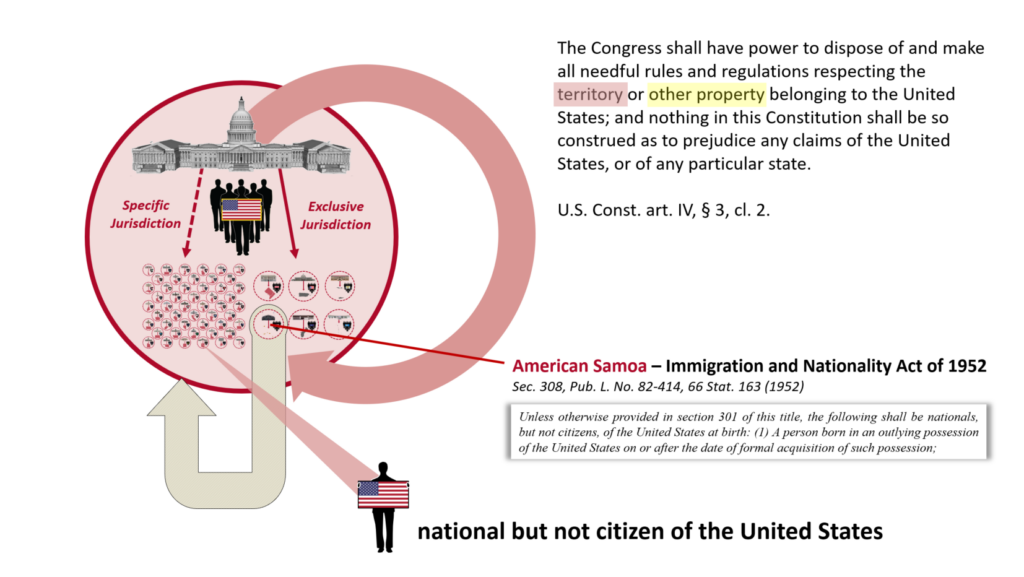
- non-citizen national status: U.S. possessions. Act of Congress via U.S. Const. art. IV, sec. 3, Cl. 2 and 8 U.S.C. §1408
- Nationality, Alienage, and Allegiance
7.1. Introduction
7.2. Tabular Summary
7.3. History - Conclusions
1. Introduction
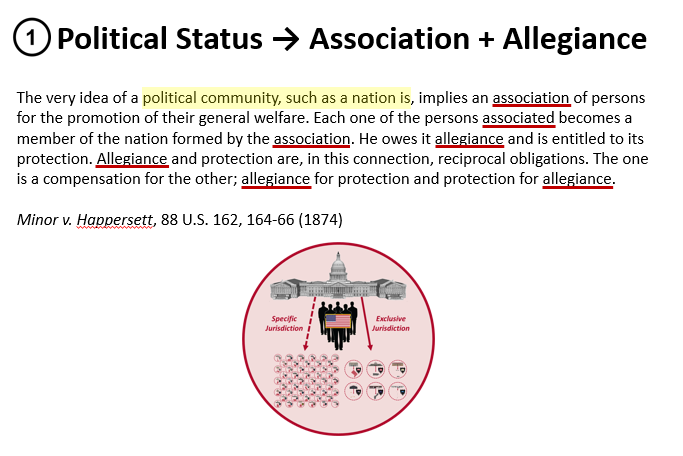
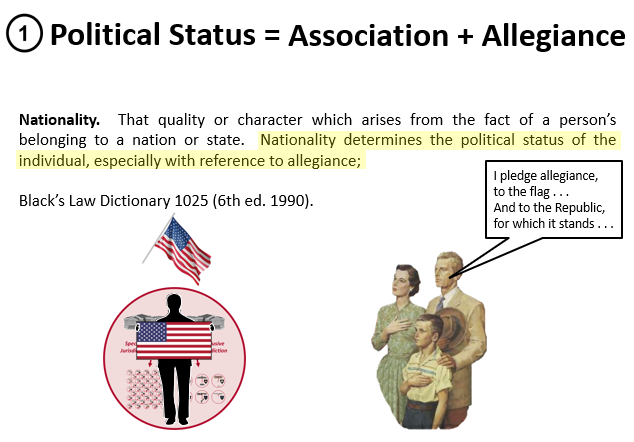
Association=Political citizen* under Fourteenth Amendment or 8 U.S.C. §1401.
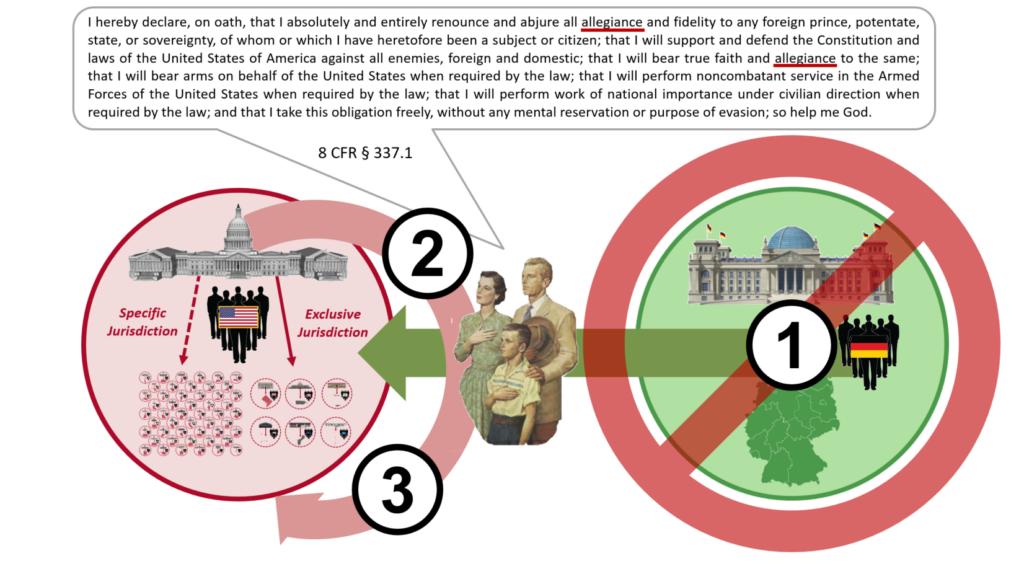
Allegiance=Naturalization oath under 8 C.F.R. §337.1.
“The very idea of a political community, such as a nation is, implies an association of persons for the promotion of their general welfare. Each one of the persons associated becomes a member of the nation formed by the association. He owes it allegiance and is entitled to its protection. Allegiance and protection are, in this connection, reciprocal obligations. The one is a compensation for the other; allegiance for protection and protection for allegiance.”
[Minor v. Happersett, 88 U.S. 162, 164-66 (1874)]
“Nationality. That quality or character which arises from the fact of a person’s belonging to a nation or state. Nationality determines the political status of the individual, especially with reference to allegiance;”
[Black’s Law Dictionary 1025 (6th ed. 1990)]
There are FIVE methods of acquiring national citizenship:
- National citizenship: 50 States & DC. U.S. Cont., Amendment XIV
- National citizenship: U.S. territories. Act of Congress via U.S. Const. Art. IV, Sec. 3. Clause 2
- National citizenship: Birth Abroad. Act of Congress via doctrine of jus sanguinis. 8 U.S.C. §1401
- National citizenship: Naturalization. Act of Congress via Const. Art. 1. Sec. 8, Clause 4 and 8 U.S.C. §1481.
- non-citizen national status: U.S. possessions. Act of Congress via U.S. Const. art. IV, sec. 3, Cl. 2 and 8 U.S.C. §1408.
2. National citizenship: 50 States & DC. U.S. Cont., Amendment XIV
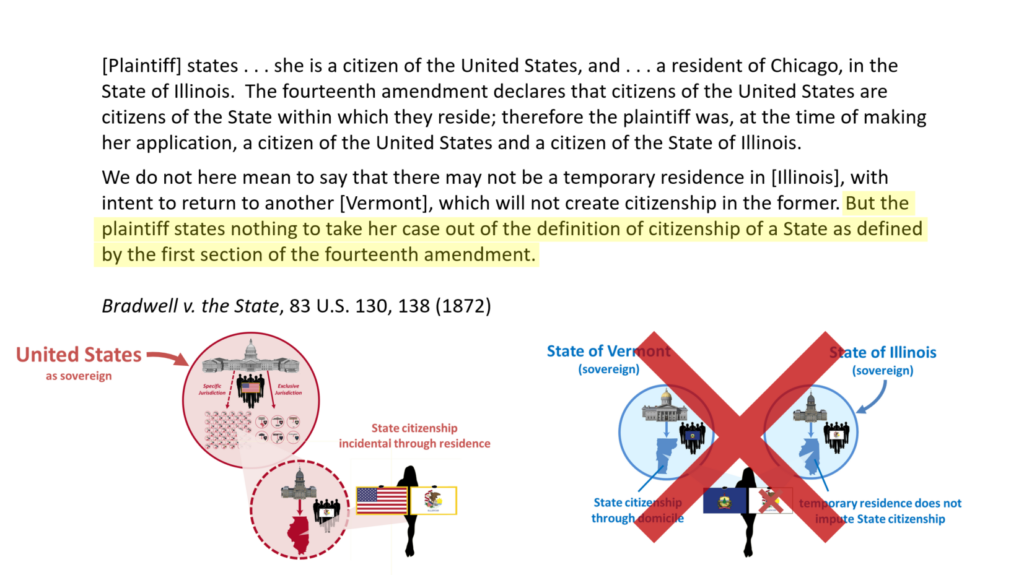
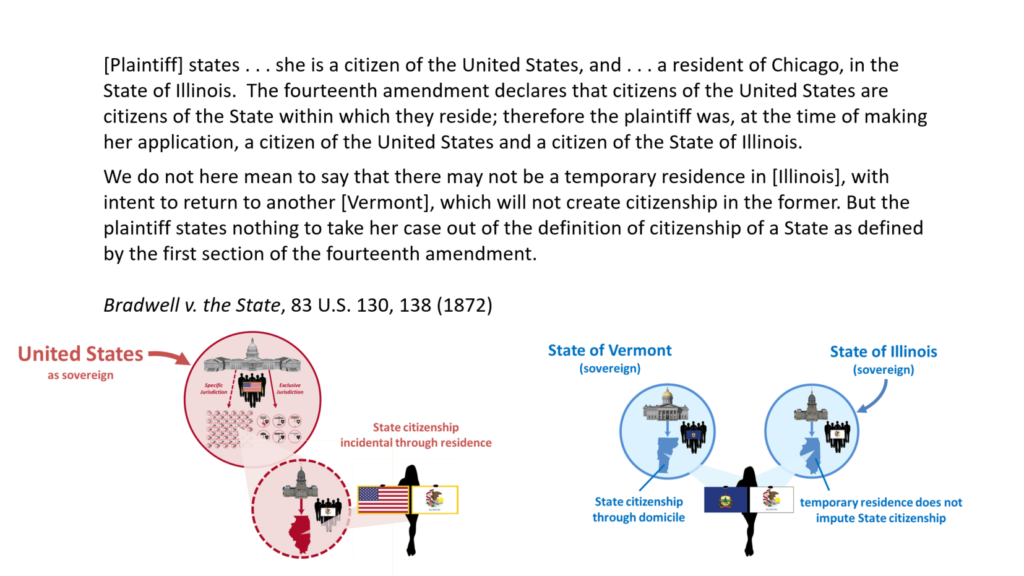
3. National citizenship: U.S. territories. Act of Congress via U.S. Const. Art. IV, Sec. 3. Clause 2
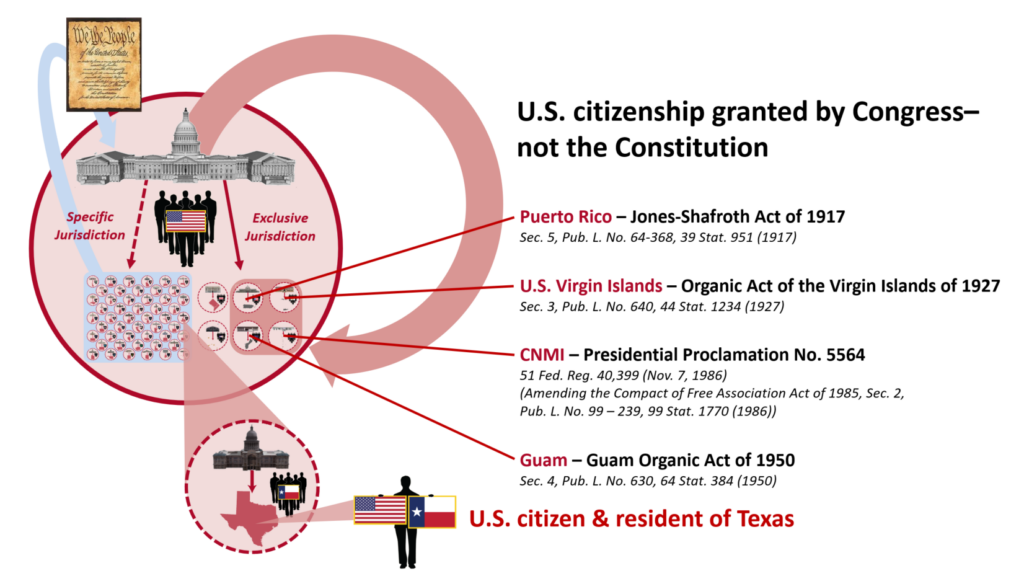
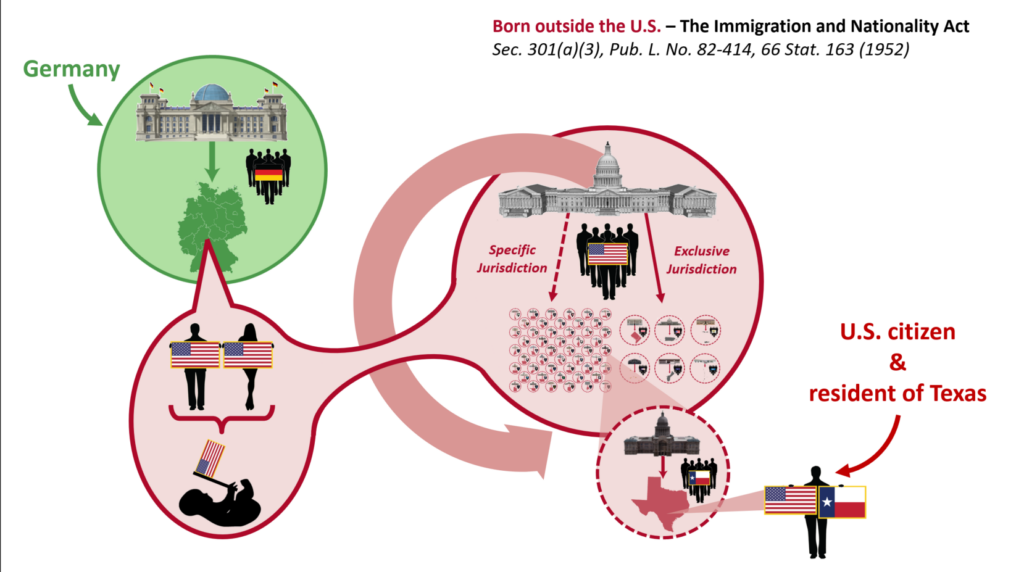
4. National citizenship: Birth Abroad. Act of Congress via doctrine of jus sanguinis. 8 U.S.C. §1401
5. National citizenship: Naturalization. Act of Congress via Const. Art. 1. Sec. 8, Clause 4 and 8 U.S.C. §1481
6. non-citizen national status: U.S. possessions. Act of Congress via U.S. Const. art. IV, sec. 3, Cl. 2 and 8 U.S.C. §1408
7. Nationality, Alienage, and Allegiance
7.1. Introduction
Foreign nationals (“Aliens”) visiting the geographical United StatesP are referred to as owing “temporary allegiance” and are the subject of an “implied license” while here:
The reasons for not allowing to other aliens exemption ‘from the jurisdiction of the country in which they are found’ were stated as follows: ‘When private individuals of one nation [states of the Unions are “nations” under the law of nations] spread themselves through another as business or caprice may direct, mingling indiscriminately with the inhabitants of that other, or when merchant vessels enter for the purposes of trade, it would be obviously inconvenient and dangerous to society, and would subject the laws to continual infraction, and the government to degradation, if such individuals or merchants did not owe temporary and local allegiance, and were not amenable to the jurisdiction of the country. Nor can the foreign sovereign have any motive for wishing such exemption. His subjects thus passing into foreign countries are not employed by him, nor are they engaged in national pursuits. Consequently, there are powerful motives for not exempting persons of this description from the jurisdiction of the country in which they are found, and no one motive for requiring it. The implied license, therefore, under which they enter, can never be construed to grant such exemption.’ 7 Cranch, 144.
In short, the judgment in the case of The Exchange declared, as incontrovertible principles, that the jurisdiction of every nation within its own territory is exclusive and absolute, and is susceptible of no limitation not imposed by the nation itself; that all exceptions to its full and absolute territorial jurisdiction must be traced up to its own consent, express or implied; that upon its consent to cede, or to waive the exercise of, a part of its territorial jurisdiction, rest the exemptions from that jurisdiction of foreign sovereigns or their armies entering its territory with its permission, and of their foreign ministers and public ships of war; and that the implied license, under which private individuals of another nation enter the territory and mingle indiscriminately with its inhabitants, for purposes of business or pleasure, can never be construed to grant to them an exemption from the jurisdiction of the country in which they are found. See, also, Carlisle v. U. S. (1872) 16 Wall. 147, 155 ; Radich v. Hutchins (1877) 95 U. S. 210 ; Wildenhus’ Case (1887) 120 U. S. 1, 7 Sup. Ct. 385 ; Chae Chan Ping v. U. S. (1889) 130 U. S. 581, 603, 604, 9 Sup. Ct. 623.
[United States v. Wong Kim Ark, 169 U.S. 649, 685-686, 18 S.Ct. 456, 42 L.Ed. 890 (1898);
SOURCE: https://scholar.google.com/scholar_case?case=3381955771263111765]
A national under 22 C.F.R. §50.1(d) cannot be an alien, because by definition they owe permanent allegiance to the United States, and that allegiance fully excludes them from alien status.
22 C.F.R. § 50.1 – Definitions.
(d) National means a citizen of the United States or a noncitizen owing permanent allegiance to the United States.
In contrast, a U.S. non‑citizen national under 22 C.F.R. §51.1 and 8 U.S.C. §1408 in certain cases is an alien because they are not always required to owe permanent allegiance and may only owe temporary or partial allegiance (22 U.S.C. §212, 8 C.F.R. §212.0 ).
22 C.F.R. § 51.1 – Definitions.
U.S. national means a U.S. citizen or a U.S. non-citizen national.
U.S. non-citizen national means a person on whom U.S. nationality, but not U.S. citizenship, has been conferred at birth under 8 U.S.C. 1408, or under other law or treaty, and who has not subsequently lost such non-citizen nationality.
22 U.S. Code § 212 – Persons entitled to passport
No passport shall be granted or issued to or verified for any other persons than those owing allegiance, whether citizens or not, to the United States.
8 C.F.R. § 212.0 – Definitions.
United States means “United States” as defined in section 215(c) of the Immigration and Nationality Act of 1952, as amended (8 U.S.C. 1185(c)).
U.S. citizen means a United States citizen or a U.S. non-citizen national.
These distinctions create a lawful but counter-intuitive situation in which two categories of U.S. nationals exist: one that is never an alien due to permanent allegiance, and one that can be classified as an alien in regulatory or administrative settings.
Passports are issued to those owing “allegiance”, which coincide with Vattel’s alien who is a “U.S. non-citizen national”.
Law of Nations, Vattel
https://famguardian.org/Publications/LawOfNations/vattel.htm
American nationals in states of the Union must disclaim and repudiate having ever owed permanent allegiance to the United States. Instead, their allegiance to the United States is temporary and conditional, while their ultimate and enduring allegiance remains under God.
- Congress’ immigration and naturalization powers apply nationwide, not only in territories. Immigration law applies in all 50 states.
- The Immigration and Nationality Act’s definition of “alien” applies everywhere the federal government regulates immigration. 8 U.S.C. §1101(a)(3).
- Temporary allegiance is limited to the common law. All statutory allegiance is permanent. The Law of Nations implements the international common law.
- Lastly, the term “nonresident alien” DESCRIBED but not DEFINED in 26 U.S.C. §7701(b)(1)(B) is NOT a SUBSET of aliens but rather a SUPERSET and a “term” to be understood as a whole and not as its component parts. The rules of statutory construction mandate this. See:
PROOF: “nonresident alien” does NOT equal “nonresident” + “alien” by statutory construction rules, FTSIG
https://ftsig.org/proof-nonresident-alien-does-not-equal-nonresident-alien/
7.2. Tabular Summary
| # | Identity | Authority | Allegiance type | Scenario | Hidden Truth |
| 1 | Foreign national “alien” | United States v. Wong Kim Ark, 169 U.S. 649, 685-686, 18 S.Ct. 456, 42 L.Ed. 890 (1898) | Temporary local allegiance (Federal) | Visiting from a foreign country with a visa. | |
| “national of the United States” | 8 U.S.C. §1101(a)(22) 22 C.F.R. §51.1 | Permanent allegiance (National) | Someone born within the exclusive jurisdiction of national government | ||
| 2 | “resident alienP“ | 26 U.S.C. §7701(b)(1) | Permanent allegiance (Federal) | Permanent resident | Taxed on worldwide income like a member. |
| 3 | “national and citizen of the United States” | 8 U.S.C. §1401 22 C.F.R. § 50.1 | Permanent allegiance (National) | Immigration, I-9 | Born within exclusive federal jurisdiction in a state or federal enclave. |
| 4 | “U.S. non-citizen national” | 8 U.S.C. §1408 8 U.S.C. §1452 22 C.F.R. § 50.1 | Permanent allegiance (National) | Immigration, I-9 | Born in a federal possession. |
| 5 | “national of the United States” who is a “nonresident alien” | 22 C.F.R. §51.1 26 U.S.C. §873 26 C.F.R. §1.1-1 | Permanent allegiance (Federal) | Passports, income tax | Owed protection in exchange for obedience to laws. |
| 6 | Fourteenth Amendment “citizen* of the United StatesP“ | Fourteenth Amendment | Permanent allegiance (Federal when abroad) Permanent allegiance (State) | Passports, income tax | Sovereignty resides in the 50 States, not the federal district. |
| 7 | INA Alien | 8 U.S.C. §1101(a)(3) | None (Exclusion) | Immigration | Defined only by what they lack for immigration purposes. |
7.3. History
- 1774-1776: The “Association” of the United Colonies recognized all inhabitants who gave allegiance as members of the “body corporate” (Articles of Confederation, 1774).
- 1898: The Supreme Court confirmed that allegiance to the sovereign (temporary or permanent) is the engine of jurisdiction (United States v. Wong Kim Ark, 169 U.S. 649 (1898)).
- 1938: Erie killed federal “General Common Law,” allowing Congress to create the INA Alien (No allegiance) to replace the Law of Nationals (LON) Alien (Temporary) for immigration control (304 U.S. 64).
- 1952-Present: The INA finalized the “Alien” in 8 U.S.C. §1101(a)(3) as an outsider with no allegiance. See:
https://www.uscis.gov/tools/glossary
8. Conclusions
- Allegiance is POLITICAL membership, not CIVIL membership.
- Allegiance is never the origin of extraterritorial civil or criminal or common law jurisdiction.
- Criminal extraterritoriality requires a statutory clear statement and a recognized jurisdictional basis.
Even one having ANY kind of “allegiance” doesn’t automatically imply that you WANT or REQUIRE or must PAY for CIVIL STATUTORY protection. Recall that CRIMINAL, COMMON LAW, and EQUITABLE protection are INVOLUNTARY, while CIVIL protection is VOLUNTARY and requires consent, election, and civil domicile. As long as you specify that you REJECT all forms of CIVIL STATUTORY protection and membership, you retain your natural, common law protections under the ill of rights and do not suffer the disabilities or obligations of CIVIL membership as a CIVIL citizen**+D.