
Detailed Jurisdictional Layers based on FTSIG Symbology
TABLE OF CONTENTS:
- List of Layers
- Voluntary/Involuntary Layer Transitions
- Comparison Table
- Example Application: Foreign National in the USA
- Judicial Corruption as a cause of INVOLUNTARY transition from PRIVATE to PUBLIC or INVERSION of the hierarchy
- Summary of Tactics Used by Corrupt Judges to make CIVIL enforcement involuntary
- Tools for Challenging Jurisdiction
- Additional Reading
1. List of layers
Court jurisdiction is invoked based on the choice of law for any given proceeding. You as the Plaintiff determine that choice of law in most cases based on ownership of the property which you are invoking protection of the court over. Ownership gives rise to the right to determine both forum and choice of law. Every good contract has a choice of law provision mandating the forum to litigate disputes. Jurisdictional authority based on law and choice of forum is broken down into layers based on the activities that trigger each layer. These activities constitute evidence of “implied consent” (invisible consent) in most cases. These layers, in turn, derive from the following hierarchy:
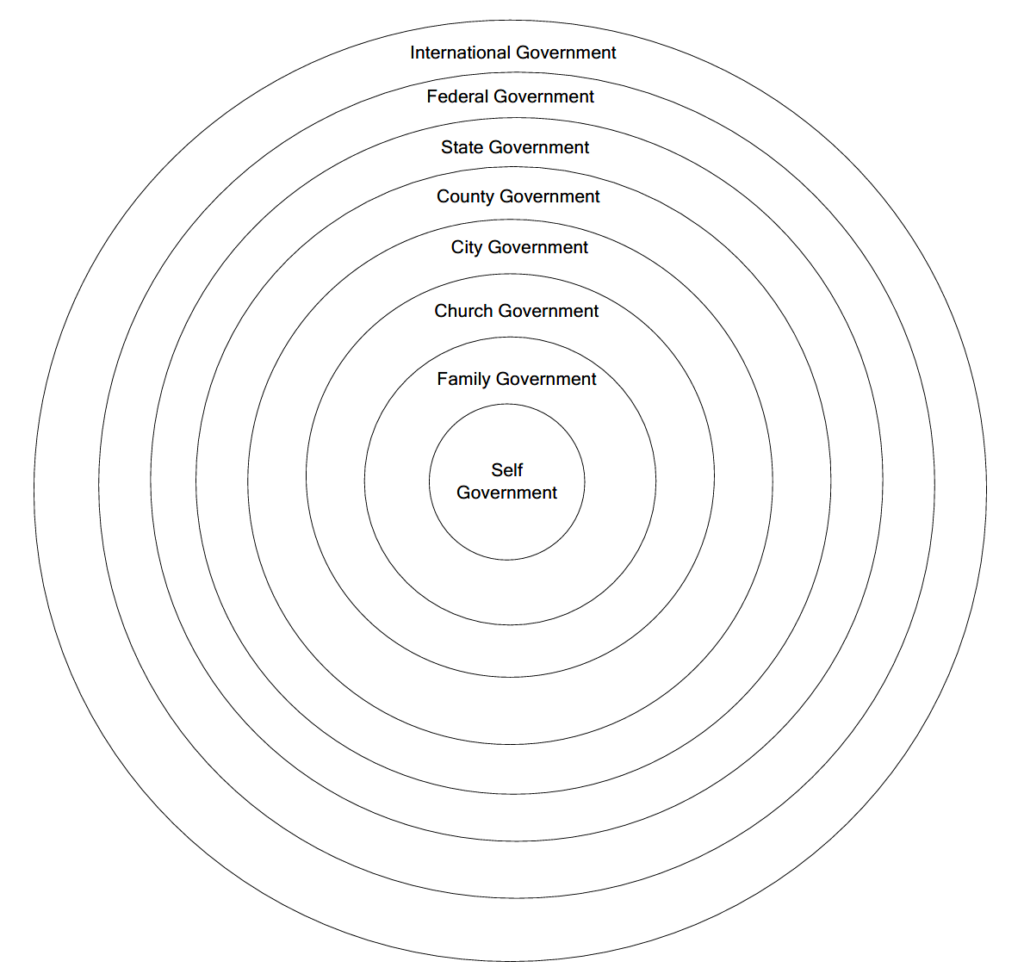
The above diagram derives from the following article:
“Sovereign”=”Foreign”, Family Guardian Fellowship
https://famguardian.org/Subjects/Freedom/Sovereignty/Sovereign=Foreign.htm
The ordering of the hierarchy layers is based on sovereignty, where you as the human are at the top and government is at the bottom. Above you, of course, is the ONLY true sovereign, who is God as reflected in the following article:
Hierarchy of Sovereignty: The Power to Create is the Power to Tax, Family Guardian Fellowship
https://famguardian.org/Subjects/Taxes/Remedies/PowerToCreate.htm
The hierarchy below documents how you as absolute owner of yourself at the center join that foreign/private property and sovereignty with the foreign layers outside the center of the above diagram.
- HUMAN: If you invoke NONE of the above, you remain exclusively private and subject only to the common law, equity, and the criminal law. These systems of law are what we call “Involuntary Protection (IP)”. The choice of law at this level is described in detail below:
Choice of Law, Litigation Tool #01.010
https://sedm.org/Litigation/01-General/ChoiceOfLaw.pdf - POLITICAL STATUS AT BIRTH: Your POLITICAL STATUS by virtue of BIRTH or naturalization at the TIME of said birth or naturalization. This makes you a CANDIDATE to invoke political jurisdiction LATER. This status is acquired by birth under the authority of the Fourteenth Amendment or 8 U.S.C. §1401.
- POLITICAL STATUS ELECTION: Whether you as someone with a POLITICAL STATUS AT BIRTH CANDIDATE choose to invoke the privileges associated with the POLITICAL jurisdiction of the court during litigation. See:
Political Jurisdiction, Form #05.004
https://sedm.org/Forms/05-MemLaw/PoliticalJurisdiction.pdf - CIVIL STATUS ELECTION: Whether you ADD CIVIL jurisdiction by invoking a voluntary domicile that ADDS to the POLITICAL jurisdiction you invoke. This creates a CIVIL STATUS. See:
4.1. Why Domicile and Becoming a “Taxpayer” Require Your Consent, Form #05.002
https://sedm.org/Forms/05-MemLaw/Domicile.pdf
4.2. This layer is ENTIRELY judicially constructed and NOT constitutional in origin. Exercising it INVOLUNTARILY is therefore “constitutionally suspect”. See:
Copilot: Origin of domicile and authority of courts to use it, FTSIG-judges COMPELLING domicile
https://ftsig.org/copilot-origin-of-domicile-and-authority-of-courts-to-use-it/ - FRANCHISE ELECTION: Whether you invoke a franchise WITHIN the civil laws of that jurisdiction that attaches to the voluntary DOMICILE. Note that a franchise election purely by contract and not based on civil domicile is a de facto franchise and not a sovereign act or de jure franchise. De jure franchises are implemented with civil law and anchored to domicile exclusively. For an example, see:
The “Trade or Business” Scam, Form #05.001
https://sedm.org/Forms/05-MemLaw/TradeOrBusScam.pdf
We can see that there are three activities involved in the above hierarchies, and each represents a specific type of Consent/Membership.
- Political Membership/Jurisdiction.
- Civil Membership/Jurisdiction.
- Individual/Contract Consent or Election: Applies to individual franchises such as licenses.
For a graphical representation of the above hierarchy, see;
Hierarchy of Sovereignty: The Power to Create is the Power to Tax, Family Guardian Fellowship
https://famguardian.org/Subjects/Taxes/Remedies/PowerToCreate.htm
2. Voluntary/Involuntary Layer Transitions
| # | Layer | Private Presence Type | Public Presence Type | Type of Consent/ Membership | Activity | Activity Example(s) | Foreign or Domestic |
| 1 | Human (1) | –> | PresenceG PresenceD PresenceF | None | Presumption or Identity Theft | 1. Judicial presumption 2. Administrative state presumption 3. RESIDENT election through bundling with government ID process.. | ForeignC |
| 2 | Human (1) | PresenceGC | None | Common law or Constitutional protections attaching to LAND without consent | Injury on geography | ForeignC | |
| 3 | Human (1) | PresenceGC | Individual/ Contract | Commercial activity under Minimum Contacts Doctrine | Business contract out of state with private party | ForeignP, ForeignC | |
| 4 | Civil Status Election (4) | –> | PresenceG | Political | Geographical area where a franchise is legislatively imposed | 1. Registering to Vote (privilege) 2. Serving on Jury Duty (privilege) Both of the above have domicile as a prerequisite. | DomesticC |
| 5 | Civil Status Election (4) | –> | PresenceD | Civil | Civil domicile | Domicile election | DomesticC |
| 6 | Civil Status Election (4) | –> | PresenceCS | Civil | Commercial activity under Minimum Contacts Doctrine involving domiciled counterparty | Business contract out of state with public party and no private choice of law specified | DomesticC, ForeignP |
| 7 | Franchise Election (5) | –> | PresenceF | Individual/ Contract | Franchise election | 1. Government Identification. 2. Social Security Number/TIN use 3. Indicating franchise status on government form. 4. License. 5. Permit. | DomesticC |
NOTES:
- POLITICAL STATUS ELECTION and CIVIL STATUS ELECTION are linked together, because as a matter of practice, no jurisdiction we are aware of will allow you to vote without a civil domicile. That is why the following layers don’t appear as rows in the above table:
1.1. POLITICAL STATUS AT BIRTH (Section 1, layer 2).
1.2. POLITICAL STATUS ELECTION (Section 1, layer 3). - Columns 3/Private and 4/Public: For an itemized list of the types of presence on this website, see:
Writing Conventions on This Website, Section 1.8: Types of CIVIL Legal Presence
https://ftsig.org/introduction/writing-conventions-on-this-website/#1.8._Types - Column 5: Type of Consent/Membership derives from the end of section 1 of this article. Namely:
3.1. Political Membership/Jurisdiction.
3.2. Civil Membership/Jurisdiction.
3.3. Individual/Contract Consent or Election: Applies to individual franchises such as licenses. - Item 7: For an itemized list of the franchise elections, see:
Catalog of Elections and Entity Types in the Internal Revenue Code, FTSIG
https://ftsig.org/catalog-of-elections-in-the-internal-revenue-code/
3. Comparison Table
We will now provide a table summarizing the the nature of each of the above jurisdictional layers. They are ordered in the same sequence as above and also characterized based on the standard symbology used throughout this website.
| # | Layer | Type of Presence | Activity | Geographical or Legal/ Corporate | Foreign or Domestic | Protection type | Applicable Law | Notes |
| 1 | Human (1) | PresenceI | Presumption or Identity Theft | Legal | ForeignC | Involuntary Protection (IP) | Presumption or Identity Theft | See: Identity Theft Affidavit, Form #14.020 |
| 2 | Human (1) | PresenceGC | Common law or Constitutional protections attaching to LAND without consent | Geographical | ForeignC | Involuntary Protection (IP) | Common law, Bill of Rights | See: Choice of Law, Litigation Tool #01.010 |
| 3 | Human (1) | PresenceCC | Commercial activity under Minimum Contacts Doctrine | Legal | ForeignP, ForeignC | Involuntary Protection (IP) | Minimum Contacts Doctrine, U.C.C., Common Law, Contract governing parties | See: 1. Minimum Contacts Doctrine; 2. Choice of Law, Litigation Tool #01.010 |
| 4 | Civil Status Election (4) | PresenceG | Geographical area where a franchise is legislatively imposed | Geographical | DomesticC | Voluntary Protection (IP) | Franchise contract or quasi- contract | United StatesG is an example. |
| 5 | Civil Status Election (4) | PresenceD | Civil domicile | Legal | DomesticC | Voluntary Protection (VP) | Civil statutes | See: Why Domicile and Becoming a “Taxpayer” Require Your Consent, Form #05.002 |
| 6 | Civil Status Election (4) | PresenceCS | Commercial activity under Minimum Contacts Doctrine involving domiciled counterparty | Legal | DomesticC, ForeignP | Voluntary Protection (VP) | Minimum Contacts Doctrine, U.C.C., Civil statutes | See: 1. Minimum Contacts Doctrine; 2. Uniform Commercial Code 3. Why Domicile and Becoming a “Taxpayer” Require Your Consent, Form #05.002 |
| 7 | Franchise Election (5) | PresenceF | Franchise election | Legal | DomesticC | Voluntary Protection (VP) | Franchise contract or quasi- contract | See: Government Instituted Slavery using Franchises, Form #05.030 |
NOTES:
- Protection Type (Column 7):
1.1. IP: Involuntary, private, common law/equity/criminal.
1.2. VP: Voluntary, public, civil/franchise/statutory. - POLITICAL STATUS ELECTION and CIVIL STATUS ELECTION are linked together, because as a matter of practice, no jurisdiction we are aware of will allow you to vote without a civil domicile. That is why the following layers don’t appear as rows in the above table:
2.1. POLITICAL STATUS AT BIRTH (Section 1, layer 2).
2.2. POLITICAL STATUS ELECTION (Section 1, layer 3). - Column 3: For an itemized list of the types of presence on this website, see:
Writing Conventions on This Website, Section 1.8: Types of CIVIL Legal Presence
https://ftsig.org/introduction/writing-conventions-on-this-website/#1.8._Types - For an itemized list of the franchise elections, see:
Catalog of Elections and Entity Types in the Internal Revenue Code, FTSIG
https://ftsig.org/catalog-of-elections-in-the-internal-revenue-code/
4. Example Application: Foreign National in the USA
Consider a Mexican national who is residing in Long Beach legally. This is very illustrative of how they are equivocating between the political sense and the geographical sense. Here is a tabular representation of their condition and the type of presence they have in each case:
| # | Jurisdiction | Layer | Franchise | Alienage | Presence Name | Presence Type | Geographical or Legal/ Corporate | Protection Type |
| 1 | City | 4 | NA | Alienage | Resident of CityG | PresenceG | Legal (VP within a geography) | Voluntary Protection (VP) |
| 2 | County | 4 | NA | Alienage | Resident of CountyG | PresenceG | Legal (VP within a geography) | Voluntary Protection (VP) |
| 3 | State | 4 | Driver License | “Resident” of StatesG | PresenceG | Legal (VP within a geography) | Voluntary Protection (VP) | |
| 4 | Federal | 4 | Federal Income Tax | Alienage | “Resident” of United StatesG | PresenceG | Legal (VP within a geography) | Voluntary Protection (VP) |
NOTES:
- The geographies above represent the jurisdiction over which a given government can preempt authority and jurisdiction over a subordinate government.
- The privilege in most cases is physical presence as an alien (alienage).
- Every layer implements a form of preemption for the government at that level, but doesn’t affect the layers below or above it. This is because it is based on property or privileges offered only by the government at that specific layer.
- Physical presence tests or purely geographical CIVIL STATUTORY jurisdiction over human beings is limited to aliens only by default. It does NOT apply to political citizens*, who are “nonresidents under the presence test everywhere, such as in 26 U.S.C. §7701(b)(1).
- Beyond these defaults, U.S. nationals may ADD a statutory status election and thus a civil privilege to surrender their Level 1 status in exchange for level 4 status. Thus, they trade rightsPRI for rightsPUB/privileges.
- State vehicle codes that MANDATE getting a driver license based on presence in the state for a specified time period DO NOT apply to U.S. nationals and are INCORRECTY applied to them.
From this example, it’s easy to see what’s going on when you apply the above concepts to a foreign national who is here legally.
5. Judicial Corruption as a cause of INVOLUNTARY transition from PRIVATE to PUBLIC or INVERSION of the hierarchy
During debates over the federal constitution, there were to two camps:
- Federalists: believed in supremacy and sovereignty of the government over the people REGARDLESS of consent. Thus, the people become CHATTEL just like the original black slaves.
- Anti-Federalists: Who placed the INDIVIDUAL and PRIVATE rights at the top of the hierarchy and the government at the bottom.
The text of the constitution doesn’t appear to favor either of the above models for political hierarchy. However, through the accretion of power by a corrupt federal judiciary since the founding of our country, America has migrated to the Federalist position above, as explained below:
- What Happened to Justice?, Litigation Tool #08.001
https://sedm.org/ItemInfo/Ebooks/WhatHappJustice/WhatHappJustice.htm - Copilot: Origin of domicile and authority of courts to use it, FTSIG-judges COMPELLING domicile
https://ftsig.org/copilot-origin-of-domicile-and-authority-of-courts-to-use-it/ - PROOF: Involuntary civil statutory obligations are a product of Judicial Corruption of Republican Principles, FTSIG
https://ftsig.org/proof-involuntary-civil-statutory-obligations-are-a-product-of-judicial-corruption-of-republican-principles/ - HOW TO: Distinguishing the LEGAL STATUS from the HUMAN, FTSIG
https://ftsig.org/how-to-distinguishing-the-legal-status-from-the-human/
The corruption of our governmental system is most noticeable in the CIVIL law area. The reason for this is that the civil statutory law:
- Is predicated on consent.
- Implements consent invisibly in the majority of cases through implied consent.
- Is the main engine for implementing collectivism in an otherwise free society.
- Waives constitutional protections.
- Allows government to evade liability for damages caused by enforcement actions. This is because the civil law functions essentially as a usufruct against your property by the government.
Corruption produced by the above is evidenced by the following government behaviors, all of which would be impossible without judicial collusion of the kind described in detail above:
- Compelled civil status elections using government ID and Social Security Number franchise marks.
- Implementation of the Public Rights Doctrine that removes disputes from Article III courts and puts them in Article I courts so that constitutional rights within the Bill of Rights can be IGNORED by the courts. See:
Catalog of U.S. Supreme Court Doctrines, Litigation Tool #10.020
https://sedm.org/Litigation/10-PracticeGuides/SCDoctrines.pdf - Abuse of the civil law to destroy the separation of powers between the state and the national government. See:
Government Conspiracy to Destroy the Separation of Powers, Form #05.023
https://sedm.org/Forms/05-MemLaw/SeparationOfPowers.pdf - Establishment of the administrative state to implement the Public Rights Doctrine. This involves the unconstitutional delegation of legislative powers by the Executive Branch. See:
Administrative State: Tactics and Defenses Course, Form #12.041
https://sedm.org/LibertyU/AdminState.pdf - The abuse of federal legislative powers to invade the states by offering franchises designed to destroy the sovereignty and autonomy of individuals. See:
Government Instituted Slavery Using Franchises, Form #05.030
https://sedm.org/Forms/05-MemLaw/Franchises.pdf
Collectively, the above forms of corruption are described and shown graphically and even tied to biblical prophecy that predicts them:
How Scoundrels Corrupted Our Republican Form of Government, Family Guardian Fellowship
https://famguardian.org/Subjects/Taxes/Evidence/HowScCorruptOurRepubGovt.htm
6. Summary of Tactics Used by Corrupt Judges to make CIVIL enforcement involuntary
The following list describes some of the tactics that corrupt judges will use to unlawfully expand their power and make civil obligations involuntary, even though they must be voluntary to be constitutional.
- Consent
- Using “implied” or “constructive consent”
- Constructing consent fictionally when no actual agreement is shown.
- Labeling obligations “quasi‑contractual”
- This frames obligations as if voluntarily agreed to, even when no explicit consent exists
- Method of defeating the above:
Requirement for Consent, Form #05.003
https://sedm.org/Forms/05-MemLaw/Consent.pdf
- Using “implied” or “constructive consent”
- Status
- Using the term “statutory status” without defining how someone becomes surety
- Judges allegedly avoid specifying whether a status is political or civil, or how a person becomes responsible (“surety”) for that status. This ambiguity makes it difficult to challenge involuntary obligations.
- Treating statutory classifications as “status” instead of property
- Framing them as inherent personal conditions, not elected or owned (private property).
- Calling someone a “resident” without proving alienage
- Creating obligations based on undefined residency categories.
- Equivocating political and civil meanings of key terms
- Using the same word in both political and civil contexts without clarifying which meaning applies.
- Method of defeating the above:
Your Exclusive Right to Declare or Establish Your Civil Status, Form #13.008
https://sedm.org/Forms/13-SelfFamilyChurchGovnce/RightToDeclStatus.pdf
- Using the term “statutory status” without defining how someone becomes surety
- Sovereignty
- Replacing consent-based jurisdiction with the single word “sovereignty”
- Judges substitute the legal bases of civil jurisdiction—consent, privilege, membership, or injury—with an undefined notion of “sovereignty,” allowing courts to assert authority without demonstrating individual consent.
- Invoking sovereign immunity broadly
- Shielding government from having to justify statutory claims or obligations.
- Expanding the “public rights doctrine”
- Allowing administrative or statutory obligations without traditional due‑process protections.
- Labeling obligations as “public duties” rather than private burdens
- Shifts the framing from voluntary civil participation to inherent obligation.
- Method of defeating the above:
PROOF: Income taxation of “nationals of the United States” within the exclusive jurisdiction of a constitutional state is NOT a “sovereign power”, FTSIG-judges equivocating POLITICAL and CIVIL citizenship to make everyone an involuntary and illegal “taxpayer”
https://ftsig.org/proof-income-taxation-of-nationals-of-the-united-states-within-the-exclusive-jurisdiction-of-a-constitutional-state-is-not-a-sovereign-power/
- Replacing consent-based jurisdiction with the single word “sovereignty”
- Property
- Refusing to classify statutory statuses as “public property”
- This avoids acknowledging that adopting such statuses might require voluntary choice.
- Avoiding discussion of property rights and substituting abstract terms
- Judges deliberately avoid addressing the property implications of civil status and instead rely on abstract power terms like “sovereignty” or “sovereign power,” which removes the issue from constitutional limits (especially the Bill of Rights).
- Method of Defeating the above:
Property View of Income Taxation, Form #12.046
https://sedm.org/LibertyU/PropertyViewOfIncomeTax.pdf
- Refusing to classify statutory statuses as “public property”
- Sophistry
- Presuming ANYTHING, including consent, status, election, etc. See:
Presumption: Chief Weapon for Unlawfully Expanding Federal Jurisdiction, Form #05.017
https://sedm.org/Forms/05-MemLaw/Presumption.pdf - Using negative claims that cannot be proven
- A major tactic of judicial argument is relying on unprovable negative assertions, which shifts the burden away from government and makes obligations effectively unavoidable.
- Engaging in what the article calls “judicial communism”
- By ignoring constitutional and statutory limits, judges effectively repeal the Bill of Rights through discretionary practices—making civil obligations compulsory by ignoring property protections.
- Presuming ANYTHING, including consent, status, election, etc. See:
- Favoritism and destruction of equity
- Lowering proof standards for jurisdiction. Examples include:
- Not requiring evidence of purposeful availment
- Treating domicile as presumed
- Treating physical presence as equivalent to legal presence
- Using rational‑basis review to dismiss challenges
- Setting a low standard of justification for government actions, making objections difficult.
- Equating statutory privileges/benefits with consideration
- Refusing to require moving party to PROVE actual real consideration.
- Method of Defeating the above:
Requirement for Equal Protection and Equal Treatment, Form #05.033
https://sedm.org/Forms/05-MemLaw/EqualProtection.pdf
- Lowering proof standards for jurisdiction. Examples include:
- Identity Theft
- Compelling domicile by mere physical presence
- This makes civil obligations unavoidable simply by being physically located in a place.
- Applying “presence tests” to people they claim should not be subject to them
- For example, applying rules meant for aliens to U.S. nationals.
- Enforcing civil statutes without proving government employment or agency
- Many statutes apply only to government actors, yet judges apply them broadly.
- Changing the “choice of law” from private‑law (lawPRI) to public‑law (lawPUB) without consent
- This maneuver effectively places individuals under public‑law obligations they didn’t choose.
- Method of defeating the above:
Identity Theft Affidavit, Form #14.020
https://sedm.org/Forms/14-PropProtection/Identity_Theft_Affidavit-f14039.pdf
- Compelling domicile by mere physical presence
7. Tools for Challenging Jurisdiction
- SEDM Litigation Tools, SEDM
https://sedm.org/Litigation/LitIndex.htm - Challenging Jurisdiction Workbook, Form #09.082
https://sedm.org/Forms/09-Procs/ChalJurWorkbook.pdf - Challenging Federal Jurisdiction Course, Form #12.010
https://sedm.org/LibertyU/ChallFedJurisdiction.pdf - SEDM Jurisdiction Database, Litigation Tool #09.003
https://sedm.org/Litigation/09-Reference/SEDMJurisdictionsDatabase.pdf - SEDM Jurisdiction Database Online, Litigation Tool #09.003** (Member Subscriptions)
https://sedm.org/litigation-main/sedm-jurisdiction-online/ - Federal Jurisdiction, Form #05.018
https://sedm.org/Forms/05-MemLaw/FederalJurisdiction.pdf - Catalog of U.S. Supreme Court Doctrines, Litigation Tool #10.020
https://sedm.org/Litigation/10-PracticeGuides/SCDoctrines.pdf - Challenge to Income Tax Enforcement Authority Within States of the Union, Form #05.052
https://sedm.org/Forms/05-MemLaw/ChallengeToIRSEnforcementAuth.pdf
8. Additional Reading
More like the above at:
- Capacity Based Jurisdictional Layers, Form #05.057-an expanded version of this page which is compatible with FTSIG terminology.
https://sedm.org/Forms/05-MemLaw/CapacityBasedJurisdictionalLayers.pdf - Government Corruption Discovery Handbook, Litigation Tool #02.011
https://sedm.org/Litigation/02-Discovery/GCDiscoveryHandbook.pdf - Government Corruption, Form #11.401-exhaustive resources on causes and results of government corruption
https://sedm.org/home/government-corruption/ - Copilot: Judicial Corruption Tactics and Defenses, FTSIG
https://ftsig.org/copilot-judicial-corruption-tactics-and-defenses/ - Copilot: Origin of domicile and authority of courts to use it, FTSIG-judges COMPELLING domicile
https://ftsig.org/copilot-origin-of-domicile-and-authority-of-courts-to-use-it/ - What is “Justice”?, Form #05.050
https://sedm.org/Forms/05-MemLaw/WhatIsJustice.pdf - How Judges Unconstitutionally “Make Law”, Litigation Tool #01.009
https://sedm.org/Litigation/01-General/HowJudgesMakeLaw.pdf - What Happened to Justice?, Form #06.012
https://sedm.org/ItemInfo/Ebooks/WhatHappJustice/WhatHappJustice.htm