

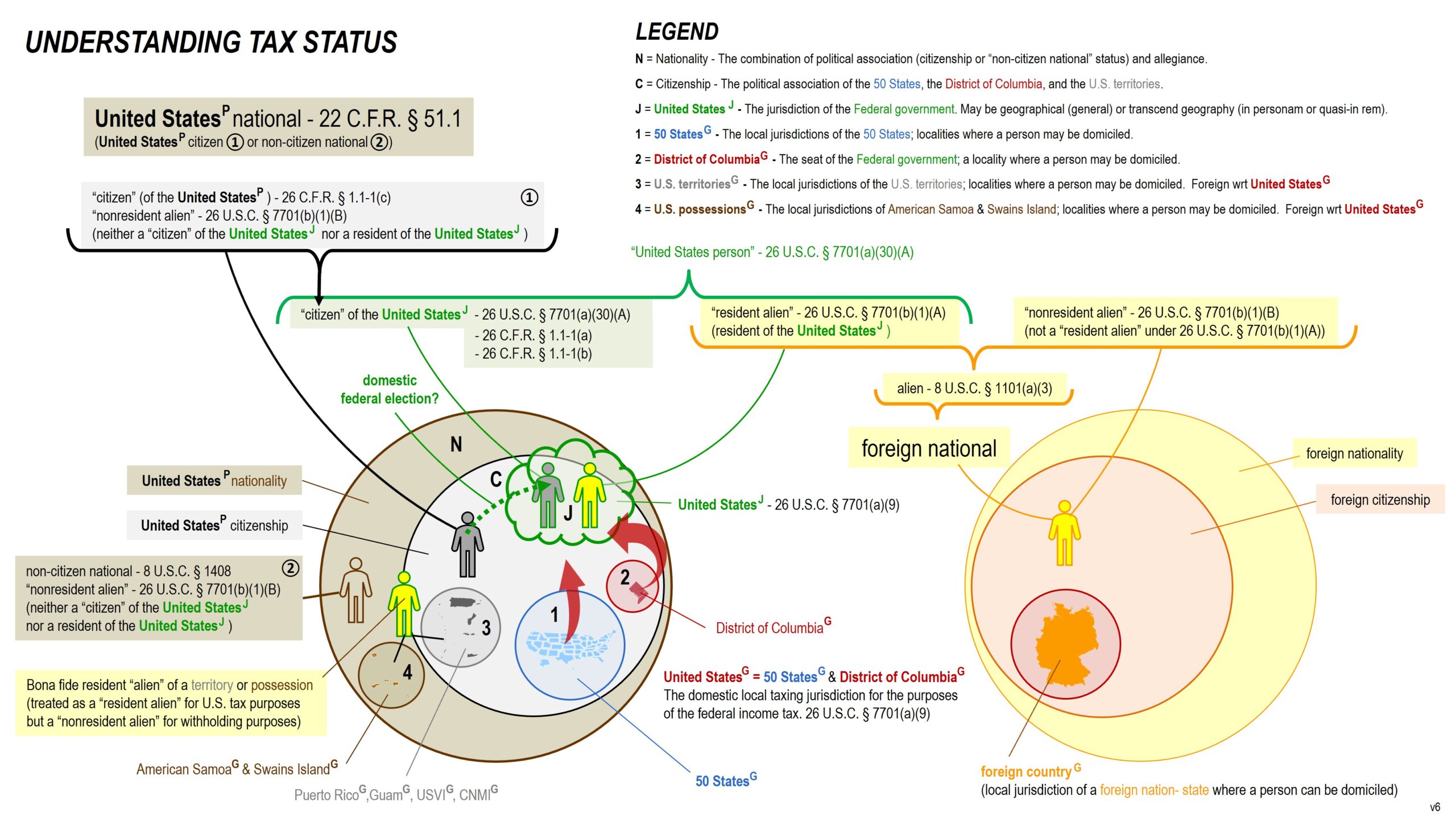
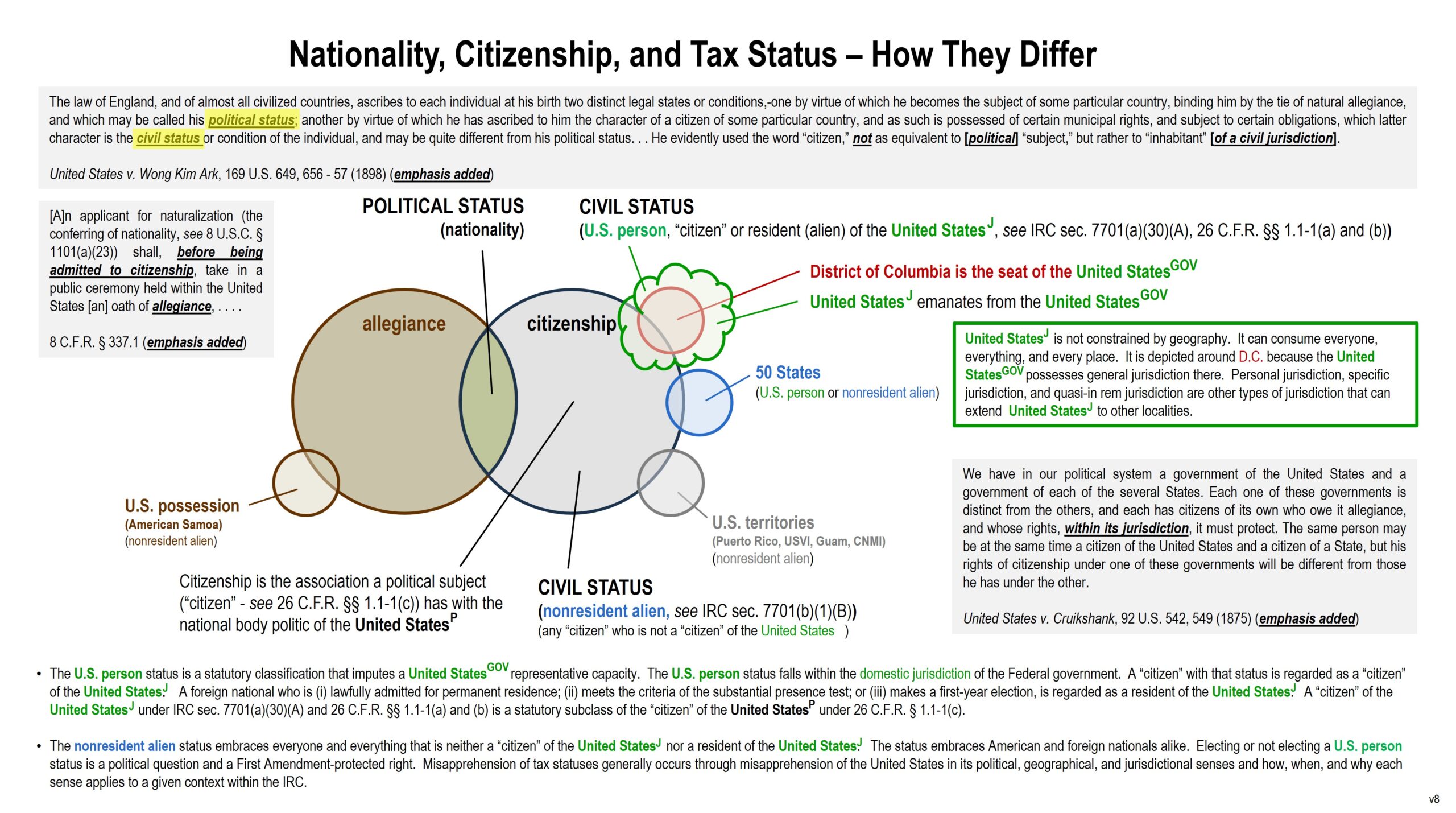
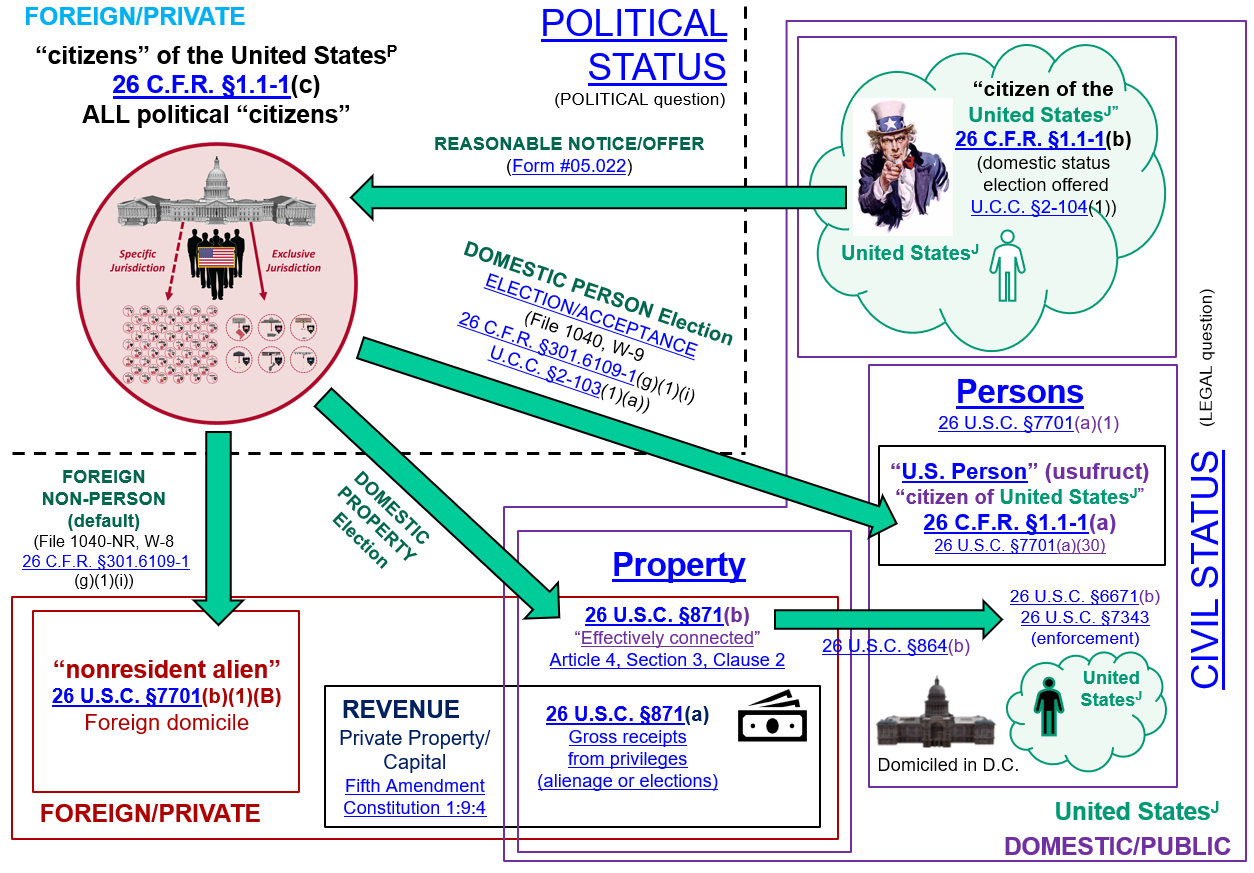
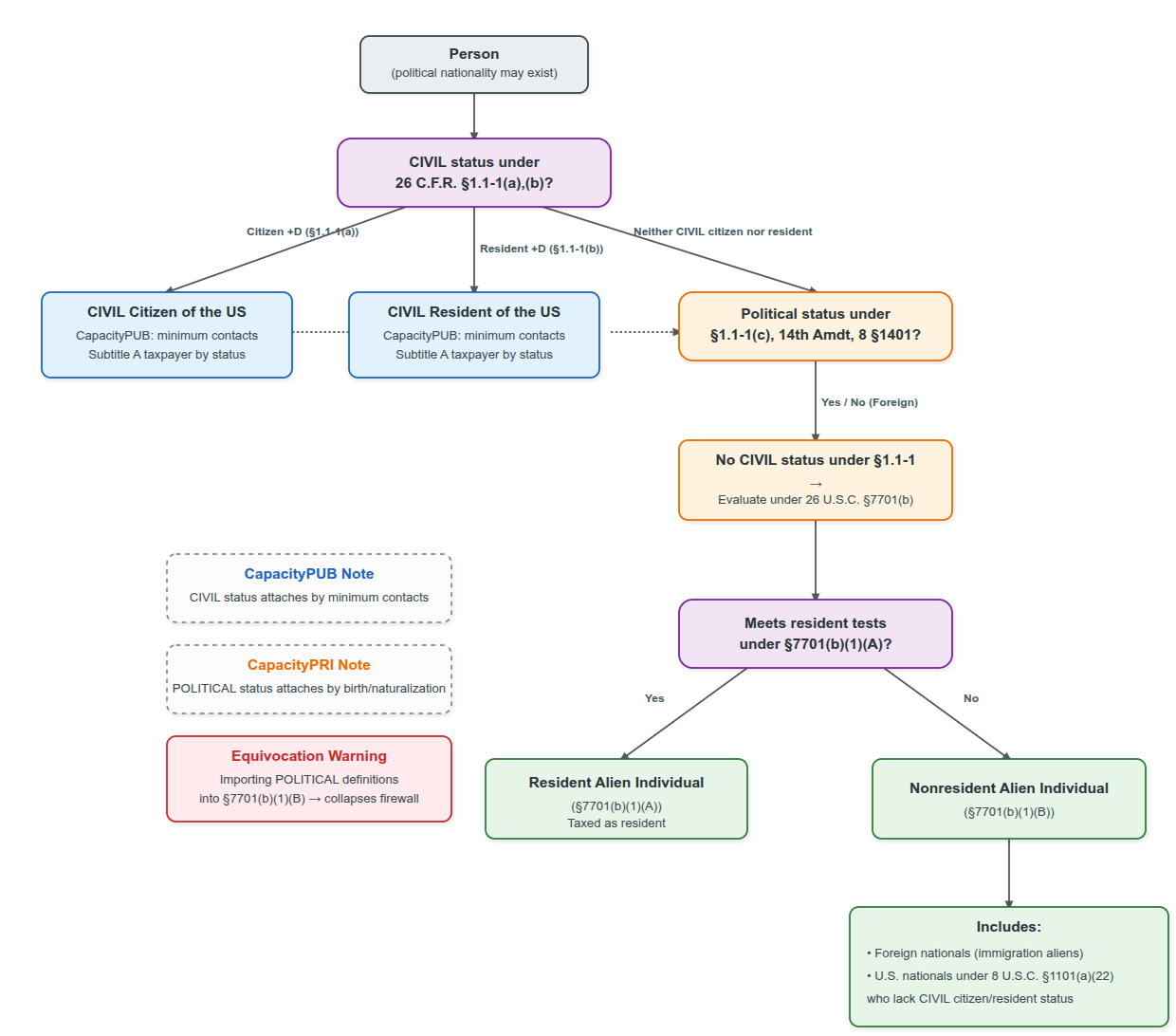
Description Of The Above Diagrams:
When it comes to income taxation, it’s NOT that tax status is imputed through citizenship alone, but rather, it is the INTERSECTION of that citizenship *AND* either a domestic or foreign civil jurisdiction. Lets apply the above diagram to the famous case of:
Cook v. Tait, 265 U.S. 47 (1924)
In the above case. Cook was an American national domiciled in Mexico who filed a 1040 return and thereby made an "election" to become "domestic". He disputed that he was subject to the I.R.C. in this scenario in the above case. We did AI discovery of this case in:
Copilot: Cook v. Tait, 265 U.S. 47 (1924) Implications
It's dangerous in the above ai discovery to discuss “political citizenship” versus “civil citizenship,” alone without fully defining the terms or context because doing so ignores the property component of making elections and the subject matter jurisdiction (SMJ) created by said elections. Otherwise, one invites the following reactions by those in government and the legal profession:
- Equivocation
- Self-serving but erroneous presumption by the government and
- Undeserved charges of being frivolous.
The following frivolous argument on the IRS website bares out this fact:
The Truth About Frivolous Tax Arguments, IRS
1. Contention: Taxpayer is not a "citizen" of the United States and thus is not subject to the federal income tax laws.26 C.F.R. §1.1-1(c)
https://www.irs.gov/privacy-disclosure/the-truth-about-frivolous-arguments-section-i-a-to-c#contentionc1
A “citizen” in 26 C.F.R. §1.1-1(c) is always political as that is the foundation of its meaning. On THIS site, we avoid these dangers by defining the following terms:
- "citizen*" as a political citizen who has made NO ELECTIONS and therefore remains private and foreign AT ALL TIMES.
- "citizen**+D" as being BOTH DOMESTIC and "clothed in a public interest". ON this site, "citizen**+D" and "civil citizen" are used interchangeably.
See:
Website Definitions, 33. “Citizen*” and “Citizen**+D” and “Citizenship”
https://ftsig.org/advanced/definitions/#33._Citizen
When litigating tax issues and in administrative correspondence, it is mandatory that you define terms the same way so as to deflect any possibility that you are being frivolous. For a rebuttal of those who disagree with this approach, see:
DEBATE: Confusion created by Citizen* and Citizen**+D nomenclature, FTSIG
https://ftsig.org/debate-confuscion-created_by_citizen-nomenclature/
The central issue instead is whether or not the “citizen” in 26 C.F.R. §1.1-1(c) wishes to elect his property into a USPI characterization (US Gov is seated in DC) or not. If he does, he is regarded as within the jurisdiction of the “United StatesG” because USPI (also now seated in DC) federally preempts StateG jurisdiction. He thus is regarded as a “citizen” of the “United StatesGOV.” If a domesticC USPI election is not made, the distinct and foreign character possessed by any of the jurisdictions of the 50 StatesG, territoriesG & possessionsG (or anywhere else for that matter) is not preempted, and the foreign status would be appropriate for the “citizen.”
The geographical sense does not literally mean the dirt upon which one stands, but rather, “United StatesG” is a way of establishing in a visually comprehensible way the extent of the domestic LOCALITY (domesticG) for the purposes of Federal taxation and its uniformity upon the local method of taxation and upon USPI which is always domesticC no matter where incident around the globe. This is why a U.S. person is taxed on worldwide income. He is a resident agent of domesticC USPI around the world.
The real issue is this: Did Cook in the case of Cook v. Tait, for instance, establish himself as being within the federally domestic subclass of all 26 C.F.R. §1.1-1(c) "citizens" through his domesticC “citizen” of the “United StatesGOV” status election on his Form 1040 filing? The answer: YES!
A “citizen” under 26 C.F.R. §1.1-1(c) like Cook was, and like most Americans are, can be without the federally domestic civil subclass by electing a foreign status (filing W-8s & 1040NRs). And a “citizen” can be within the federally domestic civil subclass by electing a domestic status (filing W-9s & 1040s). But in either instance, the “citizen” is always a “citizen” under 26 C.F.R. §1.1-1(c). It’s the domesticC election that makes him a “citizen” of the “United StatesGOV” under 26 U.S.C. §7701(a)(30)(A), 26 C.F.R. §1.1-1(a), and (b).
This is the hidden gem: There are “citizens” under 26 C.F.R. §1.1-1(c) who are “nonresident aliens” under 26 U.S.C. §7701(b)(1)(B), and there are “citizens” under 26 C.F.R. §1.1-1(c) who are “U.S. persons” under 26 U.S.C. §7701(a)(1)(A), 26 C.F.R. §1.1-1(a), and (b). But notice both groups are what we sometimes refer to as a “political citizen” under 26 C.F.R. §1.1-1(c).
When discussing tax issues, however, discussing the “political citizen”/“civil citizen” nomenclature alone absent the property implications can be misleading. It obfuscates the real issue and is teeing up everyone for a frivolous position because it supposes the wrong argument—that there are two types of citizenship. The POLITICAL citizenship doesn’t ever change. It’s the subsequent civil election of the POLITICAL “citizen” that CREATES and drives his CIVIL tax status.
The above diagram demonstrates these truths. So-called political citizenship is the central circle, and it is the common denominator of both political status (nationality) and civil status (U.S. person or NRA). But citizenship in and of itself ALONE is NOTHING of any import. It is the INTERSECTION of that citizenship with allegiance that imputes nationality. And it is the INTERSECTION of that citizenship with the red circle that creates the “U.S. person” or the blue circle that embraces a “nonresident alien” respectively. In both instances he’s still the same POLITICAL “citizen” he always was, but with the domestic election he is a “citizen” clothed in the “public interest” per Munn v. Illinois, 94 U.S. 113 (1877) and consequently regarded as a “citizen” of the “United StatesGOV.” Or, he is NOT in that class.
In that instance, he is a “citizen” intersecting the blue (other/foreign) jurisdictions, and private/foreign. But in EITHER instance, said “individual” (yes, individual) always remains a “citizen” that is political in nature. Whether said “individual” is a person under 26 U.S.C. §6671(b) or 26 U.S.C. §7343 depends on
- whether or not he is a U.S. person; or
- if not, whether or not said person is connected to a “trade or business.”
The central issue is NOT: Political v. Civil “citizen”. Instead it is:
- “citizen” with or without a domestic election.
- “citizen” clothed in or not clothed in the public interest.
We think the U.S. person status was added in 1962 (Public Law 87-834, 76 Stat. 988, Section 7(h)) to actually make THEIR position more legitimate. This is because without it, one might ask, “What comes first—the USPI connection or the status election?” Chicken or egg type of scenario.
AI Fact Pattern Tying Everything Above Together in Relationship to the Nonresident Alien Position: “Nonresident alien individual” — 26 U.S.C. §7701(b)(1)(B)
- “Nonresident alien individual” is a Title 26 term of art defined solely by the residency framework in 26 U.S.C. §7701(b).
- It is not the English composite “nonresident” + “alien”. 26 U.S.C. §7701(b)(1)(B).
- It is a negative description rather than a definition because it does not define what the person is—only what the person is not. Negative descriptions cannot create subsets.
- Because 26 U.S.C. §7701(b)(1)(B) does not define what the person is, “nonresident alien individual” cannot be a subset of “alien.”
- The terms “citizen of the United States” and “resident of the United States” in 26 U.S.C. §7701(b)(1)(B) refer to CIVIL statutory statuses under 26 C.F.R. §1.1‑1(a),(b) (Citizen+D and Resident+D), not POLITICAL statuses under 26 C.F.R. §1.1‑1(c), the Fourteenth Amendment, or 8 U.S.C. §1401.
- Because 26 U.S.C. §7701(b)(1)(B) uses the term “individual” rather than “alien individual” (as in §7701(b)(1)(A)), the category is not limited to immigration aliens under 8 U.S.C. §1101(a)(3). Congress knew how to restrict the category to aliens (as it did in 26 U.S.C. §7701(b)(1)(A)) and deliberately chose not to do so in 26 U.S.C. §7701(b)(1)(B).
- Therefore, the category “nonresident alien individual” includes:
- Foreign nationals (immigration aliens), and
- U.S. nationals under 8 U.S.C. §1101(a)(22), who are neither CIVIL citizens**+D nor CIVIL residents under 26 C.F.R. §1.1‑1(a),(b).
- The immigration definition of “alien” in 8 U.S.C. §1101(a)(3) is irrelevant to 26 U.S.C. §7701(b)(1)(B) because Congress did not use the term “alien individual” in that subsection.
- Thus, a person who is neither a CIVIL citizen (citizen**+D) nor a CIVIL resident under 26 C.F.R. §1.1‑1(a),(b) is, by the literal text of 26 U.S.C. §7701(b)(1)(B), a nonresident alien individual, regardless of POLITICAL nationality.
- CIVIL statuses under 26 C.F.R. §1.1‑1(a),(b) attach only by minimum contacts (capacityPUB), while POLITICAL statuses under 26 C.F.R. §1.1‑1(c) attach by birth or naturalization (capacityPRI).
- Therefore, importing POLITICAL definitions into 26 U.S.C. §7701(b)(1)(B) collapses the PUB/PRI firewall, constitutes equivocation, and facilitates non-consensual identity laundering.
AI Analysis Of This Page:
https://ftsig.org/copilot-analysis-of-tax-status-diagram/ in new tab)